
TRENDING TAGS :
Solar Eclipse of February 17 2026: Ring of Fire Explained
The solar eclipse of february 17 2026 will create a rare Ring of Fire in the sky. Here are exact timings, visibility zones, and safety tips you must know.

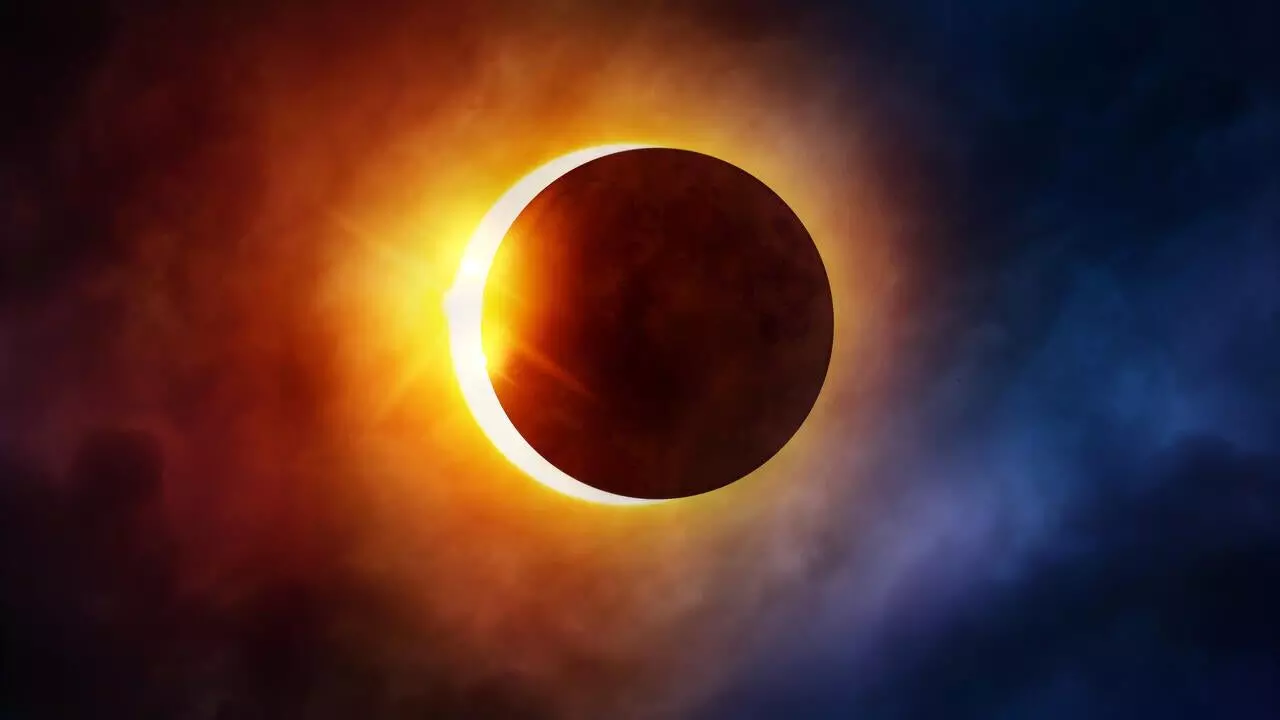
Solar Eclipse (PC- Social Media)
The solar eclipse of february 17 2026 will be an annular eclipse, not total. At peak, about 96.3 percent of the Sun will be covered. A bright ring will remain visible for up to 2 minutes and 20 seconds. It will not be visible in India, North America, or most of Europe. The best full view happens over remote East Antarctica.
What Makes This Ring of Fire Special
The solar eclipse of february 17 2026 happens when the Moon is near its farthest point from Earth. Because of that distance, the Moon appears slightly smaller than the Sun. It cannot block the Sun fully. Instead, it leaves a glowing outer ring. That is why people call it a Ring of Fire.
This is different from a total eclipse. In a total eclipse, the Sun disappears completely. In the solar eclipse of february 17 2026, sunlight never fully vanishes. The ring remains sharp and bright.
Exact Timings You Should Know
The solar eclipse of february 17 2026 follows a precise schedule in UTC time. The partial phase begins at 09:56 UTC. The greatest eclipse happens at 12:12 UTC. The partial phase ends at 14:27 UTC.
During maximum coverage, nearly the entire Sun will be hidden. Still, even at peak, it is not safe to look without protection. The solar eclipse of february 17 2026 demands proper eye safety at all stages.
Where It Will Be Visible
The path of annularity for the solar eclipse of february 17 2026 passes mainly over East Antarctica. That region is extremely remote. Research stations like Concordia Station and Mirny Station will experience the full ring effect.
Partial views will be seen in southern Africa, including Cape Town and Durban. Countries like Zimbabwe, Namibia, and Tanzania will witness a partial eclipse. Southern Argentina and Chile will also see it. Islands such as Mauritius, Madagascar, and Réunion get partial visibility too.
The solar eclipse of february 17 2026 will not be visible in India. It will also not appear in North America or most of Europe and Asia because the Sun will be below the horizon at that time.
Why Eye Protection Is Critical
Unlike a total eclipse, an annular eclipse never becomes safe for naked-eye viewing. The solar eclipse of february 17 2026 still leaves intense sunlight visible. That bright ring can damage the retina within seconds.
Certified solar viewing glasses are necessary. Regular sunglasses do not work. Solar filters designed for telescopes or cameras are also required for safe photography.
Many eye injuries during eclipses happen because people think partial coverage means safety. It does not.
Astrology And Cultural Significance
In Vedic astrology, the solar eclipse of february 17 2026 occurs in Aquarius, known as Kumbha Rashi. It falls under Dhanishtha Nakshatra. Astrologers may attach symbolic meaning to this alignment.
Interestingly, this eclipse coincides with the Chinese Lunar New Year, marking the Year of the Fire Horse. That combination makes the solar eclipse of february 17 2026 culturally notable beyond astronomy circles.
Why This Eclipse Matters
Even though it is not visible everywhere, the solar eclipse of february 17 2026 remains scientifically fascinating. It shows the delicate balance between Earth, Moon, and Sun. A slight difference in lunar distance changes everything.
Sky events like this remind us how precise cosmic motion really is. Two minutes of glowing ring. Months of preparation. Years of calculation.
If you are in the visibility zone, prepare early. If not, live streams will likely cover the event globally. The solar eclipse of february 17 2026 may last minutes, but its memory stays much longer.


