
TRENDING TAGS :
Galgotiya Controversy Analysis: Can India Ever Outgrow ‘Galgotiya-ism’?
A sharp commentary on Galgotiya-ism, jugaad culture, AI misuse, fake degrees, and India’s crisis of substance versus spectacle.

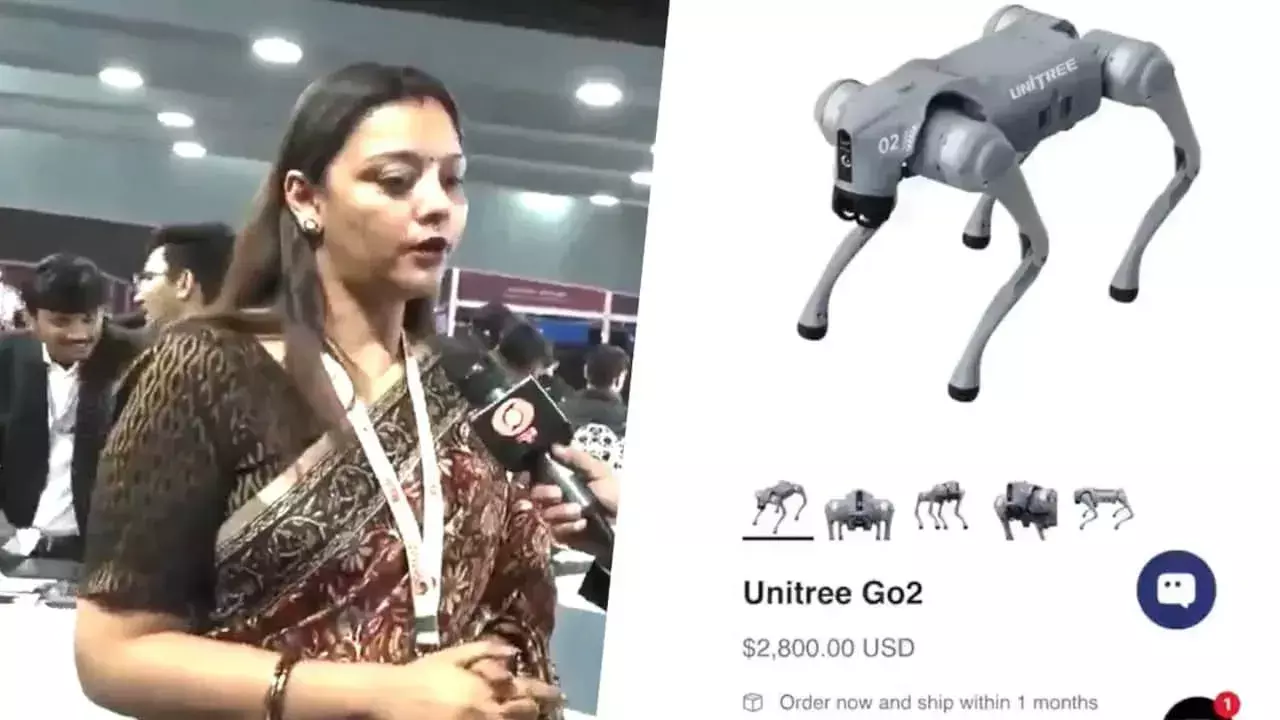
Galgotias Controversy (PC- Social Media)
In recent days, a new expression has quietly entered public conversation—almost by accident. Galgotiya-ism. Or, if one prefers, Galgotiya-style conduct. If something dubious surfaces somewhere, one might say, “It’s gone Galgotiya.” If a scam unfolds, we may call it “Galgotiya-panti.” The name is incidental; the deed is essential. Use it wherever it fits.
Recently, in the enthusiasm of acquiring a Chinese robotic dog, not just a university but its past and present students too found themselves entangled in a bout of “Galgotiya-ism.” But perhaps this is unfair. After all, what grave crime did the poor institution commit? It merely purchased a mechanical dog—paid a few lakh rupees for it, learned how to operate it, invested in publicity, showcased it proudly. And yet, instead of credit, it received ridicule.
Truth be told, what Galgotiya did was not unprecedented. It was simply an extension of something deeply familiar to us—the celebrated art of jugaad. Our unique, indigenous improvisational genius. This did not begin yesterday. It predates even the era when scooters were kick-started at awkward angles. It has merely grown more refined, more ambitious, more audacious with time.
Jugaad is not merely a word; it is a philosophy, a survival instinct, almost a cultural DNA. For many, it is a means of livelihood. Without it, the rhythm of countless lives might stall. It is innovation born of scarcity, creativity born of constraint.
Galgotiya, in essence, was only carrying forward this tradition.
Ironically, while the robotic dog attracted disproportionate limelight, few spoke of the thermocol drone once showcased as an example of inventive spirit. Instead of encouraging such enterprise, the conversation quickly shifted to derision.
Artificial Intelligence may have arrived recently, but our embedded intelligence perfected jugaad long ago. Now, with AI in play, jugaad has acquired wings. Consider this: petitions filed in the Supreme Court have cited precedents later discovered to be entirely fictional—generated by ChatGPT. This is Galgotiya-ism in a new digital avatar. Years ago, a boy from Uttar Pradesh mesmerized the nation with fabricated claims of association with NASA. How many such tales shall we recount?
Let us not be overly alarmed. Galgotiya-ism is not new.
In academia, how theses are written—or ghostwritten—is an open secret. Cheating has grown so old that it scarcely shocks anymore. Fake degrees thrive as a parallel industry; exposés surface regularly, yet the business continues unabated.
Politics is hardly exempt. Educational qualifications declared in election affidavits are seldom scrutinized rigorously. The public speculates; documentation remains elusive. Who will demand proof? And even if demanded, who will provide it?
Our entertainment industry, too, has long-standing ties with this culture—where melodies, scripts, and stories have often been conveniently “inspired” since the days of the earliest bioscope.
Which sector remains untouched? Fake IAS officers, impostor IPS officials, counterfeit doctors and surgeons, fabricated diplomats, bogus banks, sham police stations—each has, at some point, manufactured illusions for the unsuspecting. In a nation of nearly 1.5 billion, even well-educated, foreign-returned, highly placed individuals fall prey to digital arrests and lose crores. It leaves one wondering whether, in some measure, we are all Galgotians—differing only in degree.
If we were not, would we merely count as global consumers? Would we not also be innovators, producers, manufacturers? How many original inventions can we truly claim? How many patents have transformed into tangible realities? Not the kind of patents where, since its inception in 2011, an institution files 2,297 applications but secures approval for only two—neither of which materializes meaningfully.
And yet, such an institution may proudly receive an ‘A Plus’ accreditation from NAAC. One is tempted to ask: for what stellar achievement—apart from cultivating proximity to political dignitaries?
But we rarely ask. Perhaps we fear becoming victims of the very Galgotiya-ism we critique.
For consolation, we remind ourselves that zero was invented here. Without zero, the modern world—its computing systems, its engineering marvels—would collapse into nothingness. Having achieved such a monumental discovery, perhaps we hesitate to attempt another, lest we dishonor the zero itself.
Thus, Galgotiyas will continue to emerge and fade. There is little cause for anxiety. Play with a real dog; mechanical ones offer limited companionship.
That said, it would be unjust to paint all institutions and individuals with the same brush. Even within a jugaad-dominated ecosystem, there exist organizations and people quietly engaged in sincere, meaningful work.
The problem is not a single name or campus. It is a mindset—one that places branding, ranking, and spectacle above substance. One that mistakes shortcuts for achievement and publicity for progress. This mentality has consequences: in 2025 alone, nearly 12,000 startups shut down, and hundreds relocated abroad.
In the age of Artificial Intelligence, wisdom lies in preserving and nurturing our natural intelligence. If we fail, we may soon find ourselves unable to calculate two plus two without a calculator—or compose even a four-line love letter without ChatGPT.
(The author is a journalist.)


