
TRENDING TAGS :
Teaching and Learning in Adults and What Indian Knowledge Systems Teach Us
The English and Foreign Languages University (EFLU), Lucknow Campus, conducted a two-day National Workshop titled “From Teaching to Co-Creation: Anthrogogy and Indian Knowledge Traditions in the Education of Adults.”

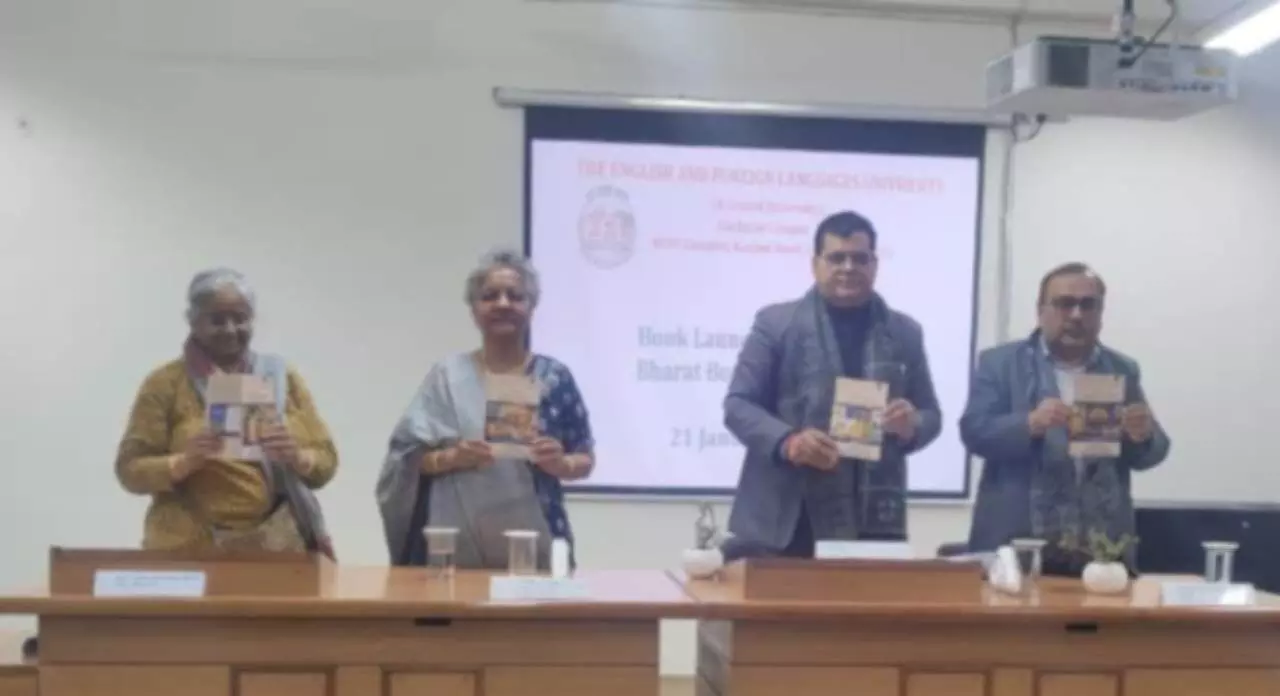
The English and Foreign Languages University (EFLU), Lucknow Campus, conducted a two-day National Workshop titled “From Teaching to Co-Creation: Anthrogogy and Indian Knowledge Traditions in the Education of Adults.”
The workshop was attended by over 60 participants, including university teachers, research scholars, teacher educators, and academic administrators from across India. The programme created a national platform for critical reflection on adult education, contemporary learning environments, and Indian Knowledge Systems (IKS).
The resource persons, Prof. Geetha Durairajan, an eminent academician and former professor of EFLU, and Dr. Shree Deepa, Associate Professor at the University of Hyderabad, focused on the concept of Anthrogogy as an integral framework for the education of adults.
The sessions foregrounded Indian Knowledge Systems (IKS) and examined the limitations of conventional pedagogy when applied to adult learners. The speakers highlighted the need for anthrogogy—a term coined by David Trott in 1991—which recognises adult learners as ethically responsible, reflective, and self-directed individuals.
In the era of ChatGPT and open knowledge resources, the idea of teachers as sole custodians of knowledge was described as increasingly redundant. Instead, teachers were reimagined as experience sharers, facilitators, and igniters of thought, whose role is to stimulate inquiry and ignite the minds of learners.
The sessions also discussed how Indian Knowledge Systems conceptualise human life as distinct from mere biological existence (Jeevanam) through the presence of Ujjivanam (conscious awareness and discernment). IKS, the speakers noted, places strong emphasis on Prayojanam—knowledge directed towards the upliftment of society, the nation, and humanity at large.
This orientation ultimately leads to Anandam, understood as a deep sense of fulfilment and well-being. The speakers further explained how IKS foregrounds the principle of Trikaranashuddhi—purity of thought, word, and action—which guides individuals towards a non-hypocritical and integrated way of life.
It was also observed that Indian languages often encode greater politeness and relational sensitivity than English. The discussion highlighted the ethical use of language for Hitam (हितम्)—the well-being of others—and Madhuryam (माधुर्यम्)—gentleness and sweetness in expression.
The sessions ended with the Valedictory session which was conducted by Dr. Vijaya, the Organizing secretary who read the report of the workshop.
It was followed by feedback from the participants who called the workshop as an eye opener in the field of IKS and Adult Education.
On this occasion, EFLU, Regional Campus, Lucknow also organised book launch ceremony of Bharat BoudhIKS books published by Vidya Bharati Uchha Siksha Sansthan.
In his address as Chief Guest, Prof Jay Shankar Pandey, Kshetra Sanyojak Vidya Bharati Uchha Siksha Sansthan asserted the idea of implementing NEP 2020 in the right spirit. He added that these Bharat BoudhiIKS books launched today are going to be a great help in understanding Indian Knowledge Systems in all three disciplines i.e. Sciences, Social Sciences and Humanities.
On this occasion Prof Rajneesh Arora, Director, Regional Campus, EFLU, Lucknow underlined the importance of IKS and invited people to visit the library as these books are made available in the library of EFLU for students and scholars. This is a great step towards the integration of IKS into the curriculum.
The Vote of Thanks was proposed by Dr. Manish Kumar Gaurav.


