TRENDING TAGS :
Kerala Assembly Election 2026: The Three-Tier Politics of Power, Structure, and Contestation
A detailed political analysis of the Kerala Assembly Election 2026, examining welfare economics, coalition management, local governance, past election trends, and the evolving LDF–UDF contest shaping the state’s political future.

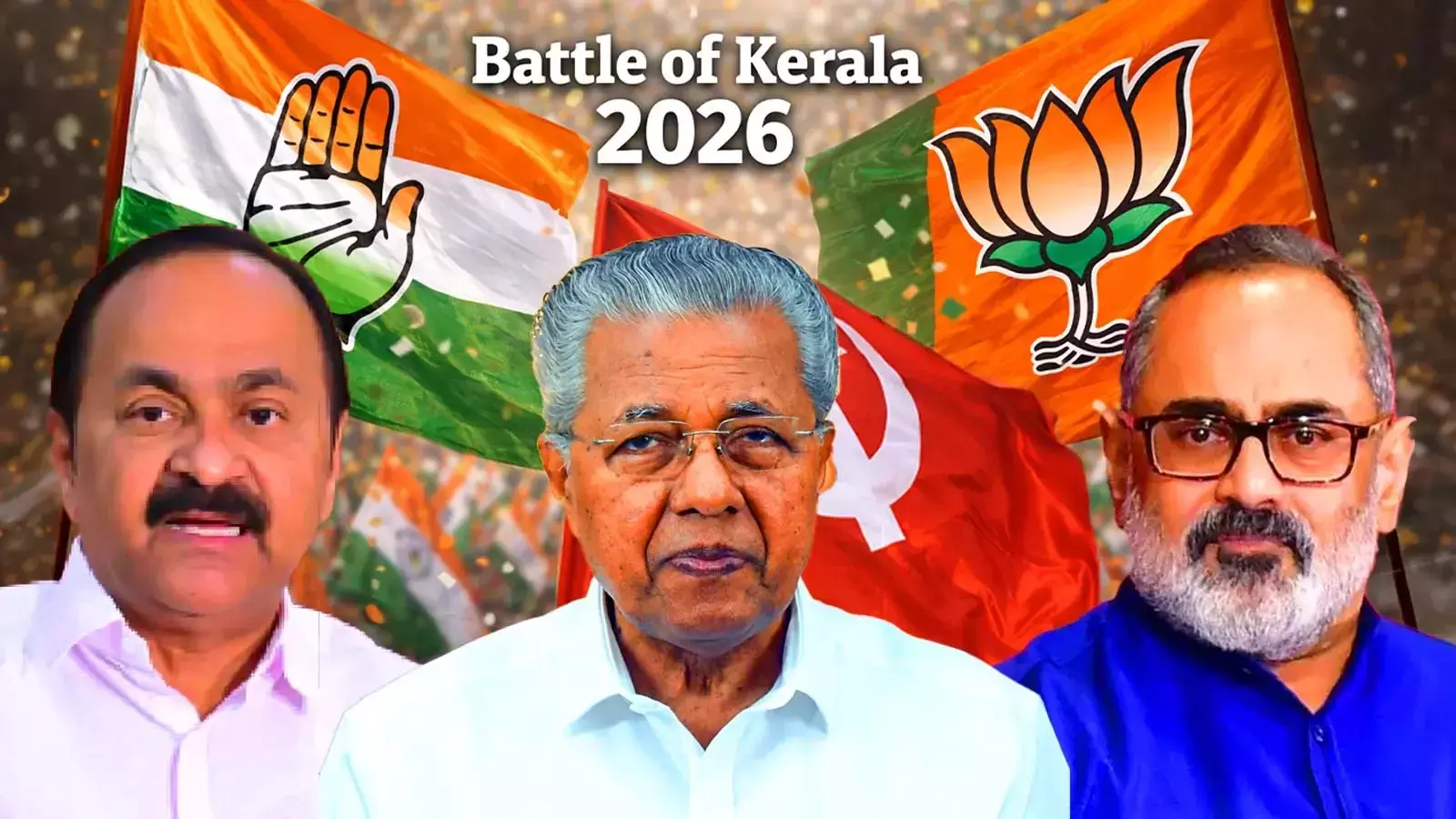
The 2026 Kerala Assembly election will be held for a total of 140 seats. Constitutionally, it is mandatory that the election be conducted before May 23, 2026. For this reason, political and administrative assessments consider April 2026 or April–May 2026 as the most likely time window for the polls.
Kerala’s electoral structure has long been different from most Indian states, as the contest has historically revolved around a single axis: LDF versus UDF. Voter behaviour in the state has been shaped by a strong tradition of “changing the government every five years.” However, the LDF’s consecutive second victory in 2021 broke this historical pattern, making the 2026 election exceptional in context.
This time, the biggest question before the ruling LDF is how to contain the emerging anti-incumbency after two consecutive terms. On the other hand, the UDF’s strategy appears to be to project the 2025 local body elections and recent grassroots signals as a “trailer for 2026,” converting anti-government sentiment into seats. The BJP/NDA, meanwhile, has traditionally followed a “breakthrough strategy” in Kerala rather than a full-scale power bid—aiming for a decisive presence in a few select urban or semi-urban constituencies. In 2026 too, its focus is likely to remain on limited but symbolically significant expansion.
Fiscal Stress vs Welfare State Model: The Central Axis of 2026
The heaviest question around which Kerala’s 2026 politics appears to revolve is the tension between state financial stress and the welfare-state model. In recent times, rising fiscal pressure on the government, revenue constraints, and repeated reports about welfare pensions and arrears have dominated political discourse.
The government has attempted to manage the situation through staggered payments and assurances. However, these developments have given the opposition an opportunity to argue that the state’s financial management is under structural strain. Alongside this, protests, human chains, and movements by government employees’ and teachers’ organisations—demanding restoration of the Old Pension Scheme, scrapping the contributory pension system, wage revisions, and payment of DA arrears—have emerged prominently.
This issue is particularly powerful among the organised government-service class, not only economically but emotionally, because it directly raises the debate of “commitment versus implementation” by the government.
Overall, LDF politics in Kerala continues to rest on the identity of the welfare state. Social security, public health, education, and the distribution system remain its primary achievement narrative. The opposition’s attack, however, is increasingly focused on the funding of this model—delays, arrears, debt, and administrative efficiency.
Local Governance, Organisation, and Voter Lists: The Real Arena of Grassroots Politics
The psychology of Assembly elections in Kerala is not shaped solely by state-level debates. Local body politics and booth-level organisation form its backbone. Based on recent local body results and trends, the UDF appears to have received a “booster” in certain regions, while the BJP has recorded a limited but noticeable presence in some urban local bodies.
These signals have directly influenced 2026 strategies. As the election approaches, both LDF and UDF have become extremely cautious about their local networks, ward-level structures, and municipal equations. In many places, internal coordination within local committees, factional alignments, and counter-strategies have themselves emerged as political messages.
Alongside this, technical issues such as voter-list revision are becoming politically sensitive in Kerala. Announcements of statewide programmes by constituent parties like the IUML indicate that in 2026, voter rolls—deletions, corrections, and inclusions—may become a major electoral battleground.
Coalition Management: The Most Fragile Link to Victory in Kerala
In Kerala, coalition arrangements are not merely background factors; they are themselves electoral issues. Within the UDF, IUML’s demand for more seats, constituency swaps in certain regions, and signals of increased representation in southern districts have surfaced.
These may appear routine, but Kerala’s political experience shows that coalition unity and balance form the strongest foundation of victory. Consequently, this entire internal debate has become a decisive component of UDF’s 2026 preparation.
The LDF faces a different challenge. It must maintain balance among constituent parties, harmonise youth and new faces with experienced leadership in candidate selection, and recreate the successful 2021 formula under altered circumstances. With the possibility of completing ten consecutive years in power, maintaining this balance will be the LDF’s most difficult strategic test.
Soft but Decisive Issues That Shape the Electoral Mood
Alongside overt political narratives, there are issues that rarely become slogans but deeply influence voter behaviour—inflation and cost of living, youth employment and overseas/inter-state migration, higher education and skilling, quality of healthcare services, preparedness for climate disasters (heavy rains, landslides), and communal harmony versus polarisation.
These affect social groups differently. Government employees prioritise pensions and DA; youth focus on jobs and opportunities; while some UDF constituents foreground social harmony and minority security. This diversity transforms Kerala politics into a multi-layered contest rather than a simple binary.
Kerala’s 2011, 2016, 2021 Elections: Vote Shares, Governments, Trends, and the Questions Ahead
Kerala politics has long been bipolar, with the primary contest between the Congress-led UDF and the CPI(M)-led LDF. The NDA/BJP’s vote share has increased at times, but seat conversion has remained limited.
2011 Assembly Election
UDF returned to power under Oommen Chandy. UDF won 72 of 140 seats; LDF secured 68. Vote share was nearly equal: UDF ~45.83%, LDF ~44.94%, BJP/NDA relatively marginal. CPI(M) won 45 seats with 28.18% votes; INC 38 seats with 26.40%; CPI 13 seats with 8.72%; IUML 20 seats with 7.92%; Kerala Congress (M) 9 seats with 4.94%. The election underscored how even a one-percent vote shift can decide government formation in Kerala.
2016 Assembly Election
A power shift brought the LDF to office under Pinarayi Vijayan with 91 seats; UDF fell to 47. Vote share: LDF ~43.48%, UDF ~38.81%. Allegations such as the Solar Scam, Bar Licence Bribery Case, and Pattoor Land Case played a major role. BJP’s growing presence was noted, but its seat impact remained region-specific.
2021 Assembly Election
LDF returned to power with 99 seats, UDF won 41, NDA/BJP none. This was historic, as it marked the first consecutive re-election of a government since 1977. Covid management, welfare policies, disaster response, and governance capacity dominated the narrative.
What Will Be the Central Question in 2026?
From 2011 to 2016 there was a regime change; from 2016 to 2021, continuity for the first time. Thus, Kerala’s “rule of alternation” broke again. In 2026, the central frame is likely to be ten years of incumbency versus change.
Key issues may include state finances and debt, welfare schemes and pensions, youth employment and migration, corruption allegations versus governance delivery, infrastructure and digitisation, and communal polarisation versus Kerala’s secular political identity.
How to Read Kerala 2026
Kerala 2026 is best understood in three layers:
1. Economy and Welfare Model – fiscal pressure versus welfare commitments
2. Local Governance and Organisation – booth-level networks and grassroots balance of power
3. Coalition Management – seat-sharing within UDF and constituent balance within LDF
The 2026 election will not merely be a verdict for or against the incumbent government; it will also answer whether the historic exception of 2021 becomes a new rule—or whether Kerala’s traditional pattern of power alternation returns.