TRENDING TAGS :
Modi’s Silence Turned Trump’s Game Around 50% Tariff Falls Flat
India’s entry into Pact Silica reshapes India–US trade ties, neutralises Trump’s tariff pressure, and strengthens India’s global role in tech supply chains.

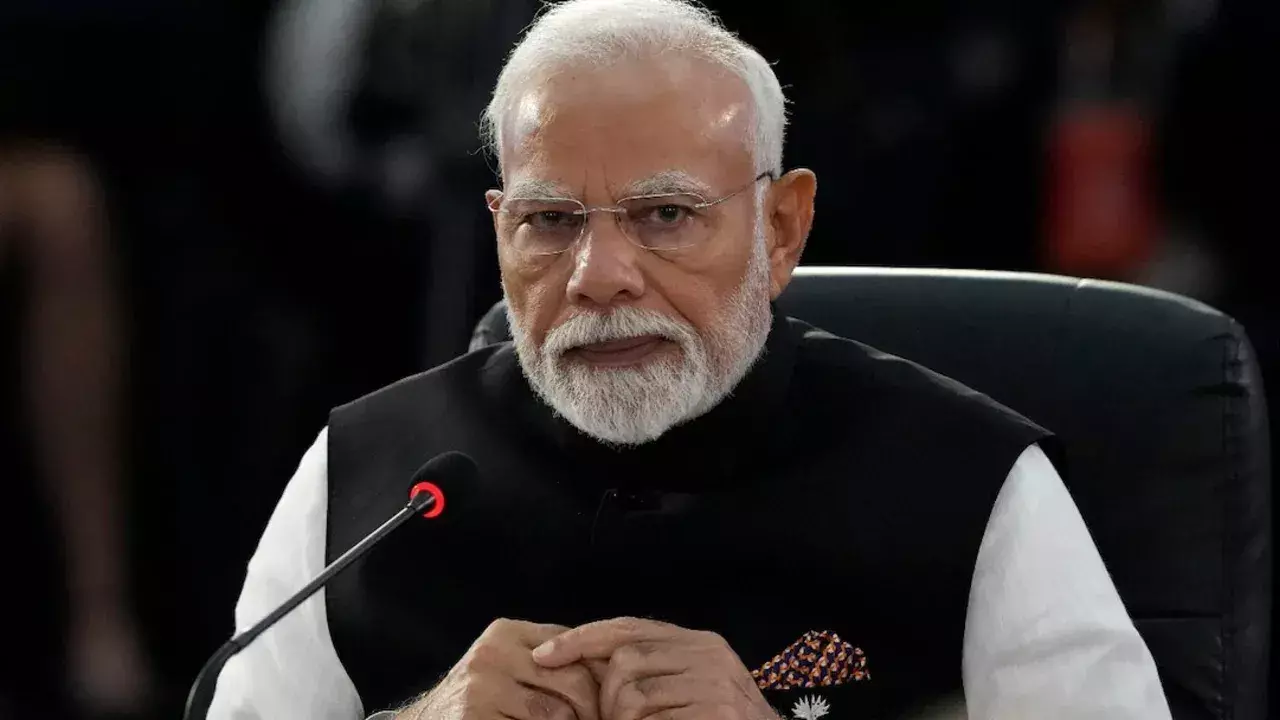
PM Modi (PC- Social Media)
A major strategic turning point is once again emerging in India–United States relations. Despite the heavy tariffs imposed by U.S. President Donald Trump, India has not been affected in any significant way. In fact, the opposite appears to be happening—India’s global standing seems to be growing even stronger. In a recent development, statements by America’s new ambassador, Sergio Gore, and the announcement that India is being included in a new strategic group called “Pact Silica” have created intense ripples across global politics.
India Stands Firm Despite Tariffs
Donald Trump had long believed that just as Europe’s powerful leaders travel to the United States and negotiate on tariffs and trade deals, India too would eventually come under pressure. But even after tariffs of up to 50 percent were imposed, India neither reacted publicly in any aggressive manner nor showed any haste. From India’s side, only the spokespersons of the Ministry of External Affairs issued balanced statements, while Prime Minister Narendra Modi, External Affairs Minister S. Jaishankar, and NSA Ajit Doval did not make any direct comment on the issue.
According to diplomatic experts, this silence was not a sign of India’s weakness, but rather an expression of confidence. U.S. Commerce Secretary Howard Lutnick himself admitted in a podcast that President Trump waited for Prime Minister Modi’s phone call for three Fridays. The signal is clear: India demonstrated openly that it does not operate on the basis of pressure politics.
A Big Statement by the U.S. Ambassador
Meanwhile, the new U.S. ambassador to India, Sergio Gore, said immediately after taking charge: “There is no country more important to America than India.”
This statement is not being seen merely as diplomatic courtesy, because Gore is counted among Trump’s closest and most powerful associates. He has played an important role in the White House, from key appointments to the formation of Trump’s core team.
Gore also made it clear that high-level discussions on a trade deal between India and the United States are ongoing, and that despite differences, both countries are capable of finding solutions. He also indicated that President Trump may visit India in the next one to two years.
What Is “Pact Silica” and Why Does It Matter?
In this entire chain of events, the biggest news is being considered India’s powerful entry into a strategic group called “Pact Silica.” This group has been created to secure the global supply chains of future technologies—such as semiconductor chips, artificial intelligence (AI), and critical minerals, among others.
Today’s world depends heavily on silicon chips and AI. From mobile phones to defense equipment and supercomputers—everything rests on these technologies. At the same time, China is widely believed to hold major dominance over the supply of rare earth and critical minerals. In such a situation, the United States and its partner countries want to build an alternative and secure supply chain in collaboration with reliable partners.
Why India’s Role Is Crucial
India is rapidly investing in semiconductor manufacturing, AI research, and high-tech industries. With a population of over 1.4 billion, India is not only a massive market, but is also being viewed as a future manufacturing hub. By becoming part of “Pact Silica,” India will gain direct access to technology, investment, and the global market.
It should be noted that countries such as Japan, South Korea, the United Kingdom, the Netherlands, Israel, the UAE, Australia, and Singapore are already part of this group. These nations possess strong networks in technology, research, and minerals. India’s inclusion will further strengthen and balance the group.
Indirect Pressure on China
Experts believe that one major objective of “Pact Silica” is also to reduce dependence on China. The world has already witnessed instability multiple times—whether due to Taiwan-related tensions, rare earth minerals, or chip supply disruptions. India’s entry into this group could redefine the balance of power in Asia in a fresh way.
Whether it is Trump’s tariff policy or international pressure, India has made it completely clear that it follows long-term strategy, not short-term reactions. India’s entry into “Pact Silica” is not just a diplomatic win—it is a major signal of India’s decisive role in the technology and economy of the future. In the coming years, its impact may become clearly visible across employment, investment, and global politics.