TRENDING TAGS :
Pandit Madan Mohan Malaviya: A Modern Educationist
An insightful article on Pandit Madan Mohan Malaviya as a modern educationist, highlighting his vision on education, language, values, and nation-building.

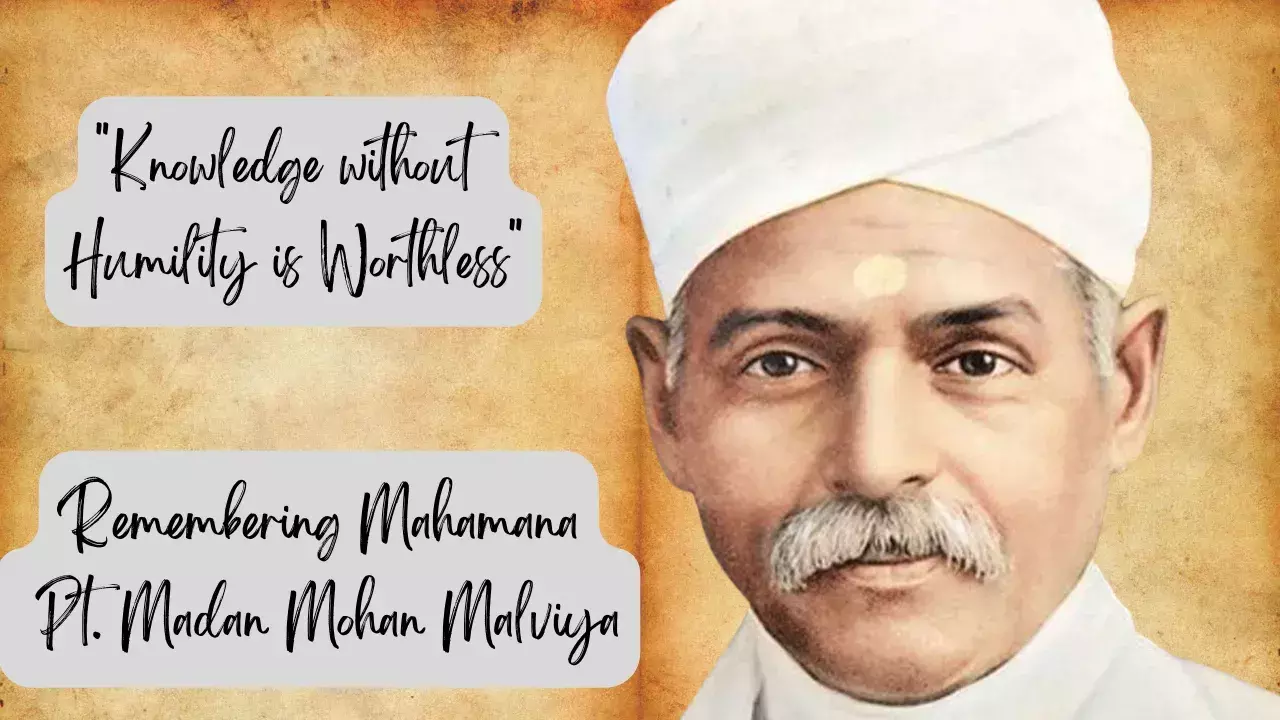
Pandit Madan Mohan Malaviya (PC- Social Media)
Bharat Ratna Pandit Madan Mohan Malaviya stands among those rare personalities in history whom the nation lovingly and reverentially addressed as “Mahamana.” This epithet was not merely an honorific; it signified recognition of his holistic vision—one in which politics, society, culture, and education were not isolated spheres, but interconnected dimensions of a single national consciousness, together giving meaning and direction to public life. Born on 25 December 1861 in Prayagraj (then Allahabad), Malaviya devoted more than five decades of his life to shaping India’s public sphere. He served four times as President of the Indian National Congress, eight times as President of the Akhil Bharatiya Hindu Mahasabha, and twice as President of the Akhil Bharatiya Hindi Sahitya Sammelan. Yet, beyond politics, his most enduring legacy lies in the field of education.
He stated unequivocally:
“There is no subject more important than education for public welfare, and the greatest duty of the government for the protection and uplift of the people is to provide them with the right kind of education.”
This assertion is as relevant for today’s youth as it was in colonial India. At a time when education is increasingly reduced to a means of securing employment, Malaviya reminds us that education is fundamentally a process of human formation—a laboratory for character, conscience, and national awareness.
Modern Vision: Primary to Technical Education
Malaviya ji can rightly be called a modern educationist because he never confined education to a single level. In 1911, in the Imperial Legislative Council, he strongly supported Gopal Krishna Gokhale’s proposal on primary education, and in 1917 he also endorsed B. N. Sharma’s proposal demanding free, compulsory, and universal primary education within fifteen years. He firmly believed that without primary education, industrial, technical, or agricultural progress was inconceivable. In his words, primary education is the foundation of all forms of education.
He advocated free and compulsory education for both boys and girls. According to him, such education would naturally weaken ignorance, untouchability, and communal bitterness. It would cultivate habits of cleanliness, strengthen society physically, morally, and intellectually, and improve the social status of women and the marginalized. At a time when inclusive education and equal opportunity are global concerns, Malaviya ji’s vision helps young minds understand that social justice is achieved not merely through policies, but through access to education.
He wanted the primary curriculum to be practical. Along with book learning, he considered useful arts, drawing, handicrafts, manual training, Sanskrit, and religious education as integral to schooling. He also emphasized optional study of subjects like chemistry and physics at the primary level—an idea that resonates strongly with today’s skill-based education and STEM models.
Malaviya ji viewed secondary education as a vital bridge between primary schooling and university education. For students aged 14 to 18, he envisioned an education that would prepare them for higher studies, while also equipping those who might discontinue formal education with employable skills. This is why he stressed industrial education alongside science and proposed at least one intermediate college in every district.
His outlook on technical and industrial education was remarkably forward-looking. Inspired by the Japanese model, he presented a comprehensive plan encompassing electrical and mechanical engineering, technical chemistry, handicrafts, art industries, and agricultural education. His proposed structure—separate secondary schools for each industry, followed by polytechnics or technology colleges, and culminating in universities—closely resembles today’s vocational-to-university pathways. Technical schools for textile and sugar industries in every district, training for managers and foremen, weaving, dyeing, carpentry, and blacksmithing were all part of his educational blueprint.
In agriculture, he wanted training to begin at the middle-school level and advocated independent degree courses in agricultural studies. He was deeply sensitive to women’s education, expressing concern over its neglect and categorically stating that there was no justification for denying women access to higher education. For today’s youth, who actively discuss gender equity, Malaviya ji’s stance remains both inspiring and instructive.
Hindi and Modern Education
Malaviya ji’s conviction that the mother tongue is the most effective medium of education was unwavering. He argued that once the government and society decide to provide textbooks in local languages, education naturally becomes more accessible, effective, and inclusive. As early as 1919, he identified Hindi as the most suitable national language and declared:
“India’s progress is possible only by adopting Hindi.”
His perspective extended beyond language to civilization and consciousness. In this context, his metaphor is especially illuminating:
“Electric light can dispel some darkness of the night, but it cannot do the work of the sun. Similarly, we cannot produce the sun’s light through a foreign language. Literature and national progress can flourish only through one’s own language.”
Throughout his life, he worked tirelessly to establish Hindi in courts, schools, and government offices. He was the first to permit answers in Hindi in high school examinations at his university. He provided financial support to Hindi authors for writing textbooks and played a decisive role in establishing the Akhil Bharatiya Hindi Sahitya Sammelan in Allahabad in 1910. For today’s youth, his message is unambiguous: true modernity lies in remaining rooted in one’s cultural foundations while engaging with the world.
For ‘Mahamana’, education was not merely the acquisition of knowledge; it was a means of character formation, analytical thinking, and spiritual training. He believed that training the soul was as essential as training the body and mind. On religious education, he remarked:
“Religious instruction, when properly understood and taught, will enhance harmony and joy in all humanity.”
Accordingly, he also considered physical and military training essential for discipline and self-defense.
Malaviya ji firmly believed that education could resolve most of humanity’s problems. In today’s world, knowledge is the greatest source of power and balance. A holistic, value-based, culturally rooted, and practical education—combined with the judicious use of technology—is increasingly visible in contemporary educational reforms. The National Education Policy 2020 and the UGC’s Malaviya Mission Teacher Training Programme clearly reflect his vision. At a time when education struggles to balance skills with values and employment with character, Malaviya ji's educational philosophy offers clear guidance to the youth. He linked education with culture, character, patriotism, social service, and the nation’s industrial and agricultural development. This is the enduring and relevant legacy of the Mahamana.
(The author holds PhD from Delhi School of Economics and is actively engaged in social work.)