TRENDING TAGS :
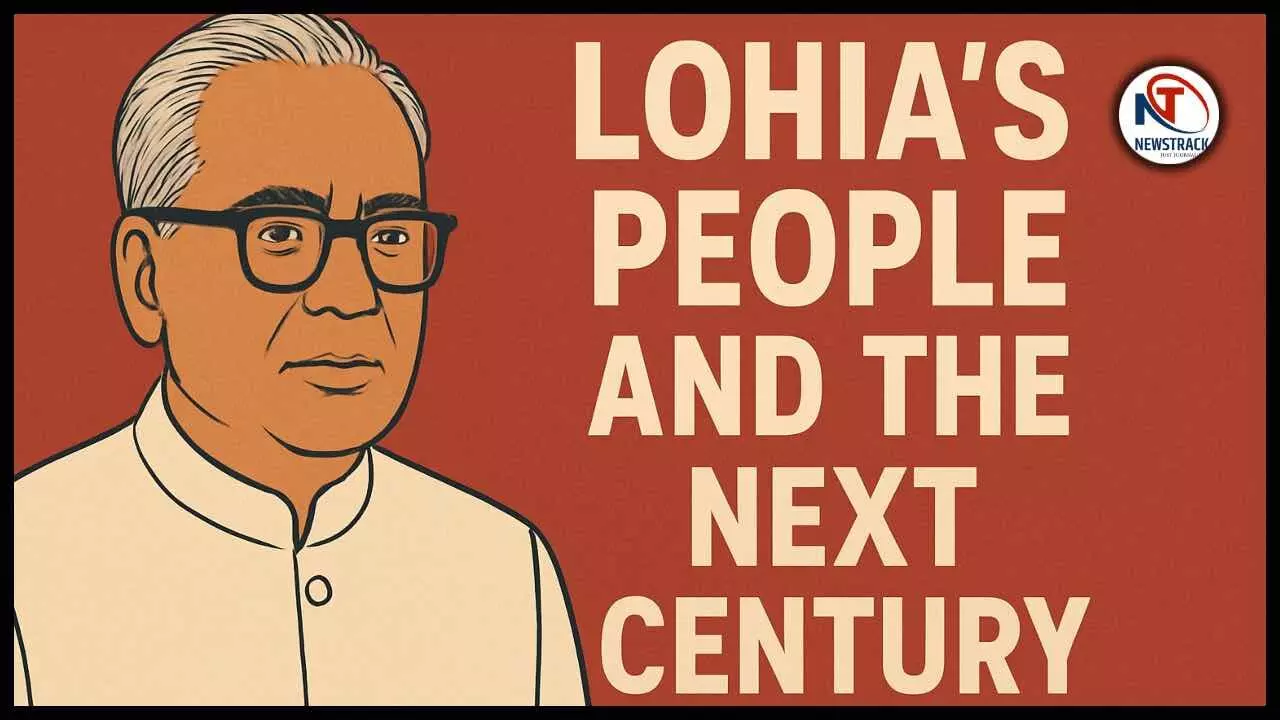
Lohia’s People and the Next Century
Lohia’s Seven Revolutions, decentralised “Chaukhamba Raj,” ethics, caste, price controls and the Opposition—why his ideas matter for the next century.
Lohia’s People and the Next Century
From my youth onward, the ideas, thought and philosophy of both Mahatma Gandhi and Dr. Ram Manohar Lohia have fascinated me—personally and socially. The difference, however, is that Dr. Lohia neither wrote an autobiography nor allowed others to peer inside his life in ways that would anchor my attraction to concrete episodes; Gandhi, by contrast, gave me many anchors through The Story of My Experiments with Truth. Even so, for me—and for many of my generation—Dr. Lohia has, in many respects, been no less a wellspring of inspiration than Gandhi. He awakened the power of character-formation and carried the fierce, inexhaustible energy to breathe life into “dead nations.”
Lohia’s life-style holds, in a sense, the composite of Rama, Krishna and Shiva: Rama’s disciplined conduct; Krishna’s courage to cast new paradigms and break old bonds; and Shiva’s resolve to drink poison for the welfare of humanity. Hence his ability to say, “If the poor get bread, my life is cheap.” No wonder former Prime Minister Morarji Desai once said that after Gandhi, Lohia was the only leader to receive such intensely loyal colleagues and followers.
When we speak of Lohia, two frames recur: “Sapt Kranti” (Seven Revolutions) and “Chaukhamba Raj” (the four-pillared republic). The Seven Revolutions: a revolution for gender equality; against racial/caste-based political, economic and intellectual inequalities; against hereditary caste and for special opportunity to the backward classes; against foreign domination and for freedom and a world commonwealth; against inequalities generated by private capital; for democratic method; and against arms and armament. Lohia would say: all seven revolutions run together across the world; in India too, we must pursue them together. His “Chaukhamba Raj” rested on Gram (village), Zila (district), Prant (province) and Kendra (centre)—that is, decentralisation. The late-20th-century constitutional strengthening of Panchayati Raj moved in the very direction Lohia had long championed.
Lohia’s “Sapt Kranti” address is to his thought what Hind Swaraj is to Gandhian philosophy—a distilled essence and, equally, a point of departure for gender equality. He spoke of people’s language, dress, dwelling and food (lok-bhasha, lok-bhusha, lok-bhavan, lok-bhojan). His language view was unequivocal: as long as English reigns, corruption will persist and democracy cannot be consummated—because the English-knowing intermediary will remain entrenched. Yet, despite a Lok Sabha resolution and constitutional mentions, the resolve to end English hegemony has been flouted for 67 years.
I never saw Dr. Lohia, and what I know comes from his books and writings by his followers. My true intellectual “proximity” to him formed when, as a student of economics (circa 1984–85), I had to choose a research topic. Across India—not only at Allahabad University—Karl Marx animated youth, not just on revolution but on society and aesthetics. Marx wrote, “All the social relations depend on economic determinants.” Set against India’s civilisational inwardness, this materialist axiom seemed to me incomplete. I therefore decided to research “The Relevance of Marx.”
Before that, in my student-politics years, I had come in contact with “Chhote Lohia,” the late Janeshwar Mishra. We would visit his upstairs flat in Naya Katra to learn the craft of public speaking, argumentative method, and the protocols of dissent/consent. From him I heard many Lohia anecdotes. When I told him about my research plan, he urged me to read Lohia’s essay “Economics after Marx.” Much that Lohia laid down there, I too found myself concluding: e.g., Marx, however deep his class analysis, was uncomprehending of caste—decisive in India.
Marx was a captive of Euro-centric superiority. Without capitalism there could be no Marxism. Communism largely took over capitalism’s means of production; it changed mainly relations of production—substituting State monopoly for private. Thus communism is less capitalism’s “antithesis” than its “sibling.” Marx abstracted capitalism away from imperialism—so many of his inferences misfired. Lohia began that essay underground during Quit India, after (in his words) “the communists betrayed the national movement,” but his arrest left it unfinished. Reading Economics after Marx gave me both joy and pain—joy at finding a strong instrument to examine Marx’s assumptions; pain that Lohia could not finish the essay. Later compilations padded with footnotes as Economics after Marx do not, in my view, do justice to the original draft’s arc.
In my dissertation I tried to push that thread forward. Happily, Chhote Lohia lived to see it completed and praised it. That was when I drew nearest to Lohia’s world of ideas. A few compact lessons that have stayed with me: Lohia maintained that statues or memorials should be raised three centuries after a man’s death—only then can bias dissipate and sober judgment prevail. He would often say, “People will indeed understand me, but after I am gone.” On his centenary, our duty is to think how to keep him actively alive through the next century. From his thought, literature and social practice I take a few essential threads—not exhaustive perhaps, but to me indispensable.
Method of struggle. Gandhi taught the method of non-cooperation; Lohia, of civil disobedience—aimed at rendering power “paralytic” without violence. He did not only preach it; he modelled it—how to behave in jail, how to face official excess. In an age when some squat on tracks and burn buses, Lohia seems even more relevant: “We will not kill, and we will not obey.” He also held that women are especially suited to satyagraha; their presence reduces the chance of fisticuffs and violence on the streets.
Turn the pages of Lohia’s collected works and you see how many mothers’ laps he’d known—dhoodh from women across castes and communities: jamadarin, sunarin, nai—embodied in the current that flowed through his house. Little wonder he bore an equal measure of compassion and respect for women; he could not accept the idea of any woman being “unbeautiful.” Practices like the housewife eating last, burqa/ghoonghat, “huyi-mui” (shrinking away from men)—he opposed them. His horizon on women’s freedom goes even beyond contemporary feminist idioms.
He urged Indian women to be “Draupadi.” In Shanti Parva, as Bhishma on his bed of arrows discoursed on statecraft, Draupadi laughed; Arjuna asked why; her answer—“When the outraging of my modesty was underway in a full court, what was Grand-sire doing?” Lohia wanted Indian women to become such questioners. He believed that in matrilineal orders, educated men learn the art of adjustment themselves.
Today’s big question—price rise. In 1952 Lohia had already said “Fix prices”—keep a minimal spread between cost and selling price. Today, spreads of one-to-a-thousand exist. Remember how onions fell from ₹60 to ₹10 only after a groundswell forced export curbs. That is Lohia’s living relevance: “Living nations do not wait five years.”
Who carries the idea? For Lohia, the party is the apparatus of thought—and sits above government because the party builds public support. His organisational maxim—“freedom in speech, discipline in deed”: full openness in discussion but, after decision, collective obedience. When the Karpuri Thakur government in Bihar failed to deliver substance, Lohia stopped seeing ministers—telling Bhupendra Narayan, “Why not shift the capital Patna to Delhi?” On breach of discipline he was volcanic.
On caste politics, Lohia was unsparing: casteist elements had hollowed out India’s soul. No caste-hierarchy can sustain justice; it prepared even the ground for Partition. On religion in politics he asked: “When every party already contains Hindus and Muslims, why a Muslim League?” And do not forget who voted for Pakistan in 1945. His larger point: “There is life beyond assemblies; elections aren’t everything.”
The Opposition’s role. Till 1963 not a single no-confidence motion was moved against Nehru. The first was by Acharya Kripalani—at Lohia’s urging. Facing Nehru’s aura required spunk; Lohia had it. After Nehru’s passing (27 May 1964) he vowed silence for six months; later, with telling irony, quipped: “Nehru gave property to the family, and ashes to the nation.” That sharpened sensibility marked his political ethics. Why is it that today the Opposition rarely musters comparable force on any issue? The start made on the Indo–US nuclear deal fizzled.
Socialism in one line. Lohia framed it as “equality plus prosperity.” Communism seeks equality by pulling down the top; socialism by lifting the bottom up. Today, prosperity rises while equality falls. Arjun Sengupta’s report—77% of Indians subsist on ≤₹20/day; in 2010 unemployment swelled by 3.9 crore; the ranks of low-wage earners increased by 21.5 crore; India languishes low on the Human Development Index. Lohia’s relevance is thus more urgent for the next two hundred years: reservations as “special opportunity,” “backward get sixty of a hundred”—to be carried in spirit to the last person.
Corruption. Lohia distinguished two faults—of character and of understanding. The latter is more dangerous, for it rationalises itself. A few vignettes. In 1967, B.P. Mandal reached Lok Sabha, then left to become a minister under Karpuri Thakur; Lohia said: “People sent you to Lok Sabha—leave the ministry, else leave the party.” Mandal chose the ministry—and later joined Congress. Irony: his name became synonymous with the Mandal Commission. In 1962 Raj Narain lost from Banaras; he entered the Rajya Sabha through manoeuvre; Lohia did not speak to him for two years—“One rejected by the people must not slip in through the back door.” In 1967 at Kannauj, when asked “Should Muslims too have only one wife?” Lohia said unflinchingly, “Yes—one wife for all.” The political cost—he won by just 500 votes; but he would not bargain on principle. In Delhi, when asked “By how many votes did you win?” he shot back: “By double your number—plus one.”
The lure of office. After Nehru’s death, Lal Bahadur Shastri offered him the Planning Commission with cabinet rank; Lohia said, “I am in the Opposition; I won’t join.” In 1953, when Nehru offered portfolios—education, home, foreign affairs—Lohia, Acharya Narendra Dev, and Jayaprakash all refused. Such fidelity to conviction is what gives long life to ideas.
I have read Lohia in English; these days I am working through his Hindi Rachanavali. Some translations jar: “healthy mind” rendered as “sudol dimaag” (well-formed head) instead of “swasth mastishk”; “waitress” as “maharin” instead of “paricharika/sevika”; “vulgarity” as “ashleelta” when context called for “abhdrata.” I’ve noted two-dozen such slips. My request is simple: refine these volumes and make them affordable—the current ₹6300 price locks out the common reader.
One more lament. Years ago Husain designed Lohia’s book covers. Inspired by Lohia, Husain also painted Hindu deities—hundreds of canvases on the epics and Puranas—gifted to Samata Nyas, Hyderabad. Those paintings were vandalised; Husain was hounded into exile; but Lohia’s people kept silent. Why no support? Lohia also wrote book reviews—the most searing on Nirala’s Chaturi Chamar. In politics it was Lohia who first took on Nehru; in literature, Nirala. When Nirala was ill, Lohia visited him—no other leader did. Both were made of the same mettle; hence, both live on. We could not keep Nirala alive even for a century; Lohia has stayed alive on the strength of his deeds, dharma and literature. Now, keeping him alive for the next two centuries is on Lohia’s people.
Finally—Lohia’s birth-date is uncertain; he observed 23 March as his birthday, the day when Bhagat Singh, Rajguru and Sukhdev smiled at the gallows. Lohia’s people owe a duty to those martyrs—not mere remembrance, but renewal of resolve.
(23 March 2011, Lucknow—Valedictory of Dr. Ram Manohar Lohia Centenary, organised by the Samajwadi Party)