TRENDING TAGS :
Sukhoi Su-30MKI Crash in Assam: IAF Confirms Loss of Two Brave Pilots
Two Indian Air Force pilots lost their lives after a Sukhoi Su-30MKI fighter jet crashed in Assam’s Karbi Anglong during a routine training mission on March 6, 2026.

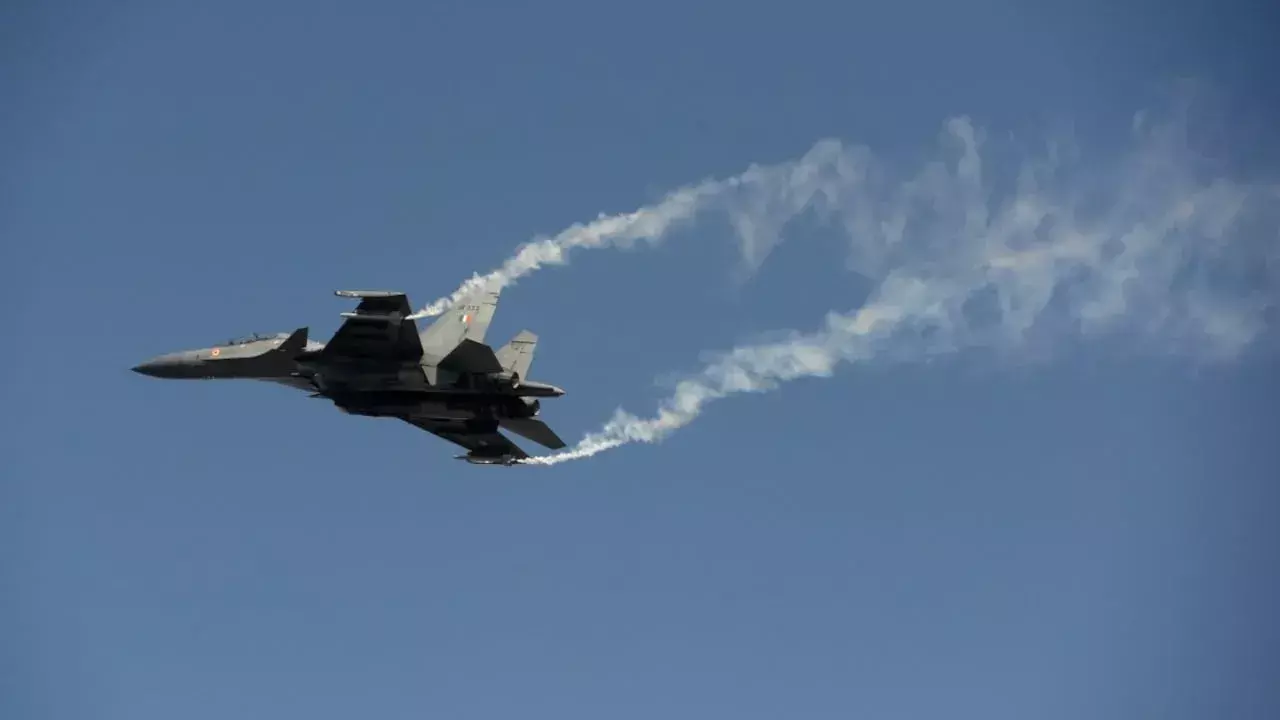
Crash (PC- Social Media)
The Indian Air Force confirmed on March 6, 2026 that two pilots lost their lives after a Sukhoi Su-30MKI fighter aircraft crashed in Assam’s Karbi Anglong district during a routine training mission. Squadron Leader Anuj and Flight Lieutenant Purvesh Duragkar suffered fatal injuries in the crash. The Air Force expressed deep condolences and said the entire force stands with the families of the officers.
It’s the kind of news nobody likes reading. A training mission, a normal day in the sky, and suddenly something goes terribly wrong. Fighter pilots know the risks of their profession, yet moments like these still shake the entire nation.
The Sukhoi Su-30MKI is not just another aircraft. It’s one of the most powerful fighter jets in India’s defence fleet. Losing trained pilots while operating such a machine reminds people how demanding and dangerous military aviation can be.
What Happened During The Training Mission
The aircraft was flying a routine sortie over Assam. Everything seemed normal at first. Then suddenly radar contact with the fighter jet was lost while it was over the Karbi Anglong area, roughly 60 kilometers from Jorhat.
When radar contact disappears, it instantly triggers alarm. Air defence networks monitor flights constantly, so even a small interruption raises concern. Within minutes, the Indian Air Force launched a response.
Search and rescue teams were sent to the region. Local administration and security agencies joined the effort as well. Forest terrain in Karbi Anglong is not easy to navigate, so locating the crash site took some time.
Eventually the worst fears were confirmed. The aircraft had crashed, and both pilots sustained fatal injuries.
IAF’s Official Statement After The Crash
Soon after confirmation, the Indian Air Force released a message on its official social media platform. The statement acknowledged the loss of Squadron Leader Anuj and Flight Lieutenant Purvesh Duragkar.
The message said the entire force expresses sincere condolences to the bereaved families. It also stated that the Air Force stands firmly with them during this extremely painful time.
Statements like these may look formal, but behind the words there is real emotion. The defence community is tight-knit. Pilots train together, fly together, and depend on each other with their lives every day.
So when one aircraft goes down, it affects the entire unit.
Where Exactly Did The Crash Happen
The crash occurred in Karbi Anglong district of Assam. This region lies in the northeastern part of India and is known for its hills and dense forests. The crash site was around 60 kilometers away from Jorhat, a city that hosts important air force facilities.
Terrain plays a huge role during aircraft incidents. Dense forest areas often make rescue operations slower and more difficult. Helicopters, ground teams, and local authorities all need coordination to reach such locations.
Search teams were immediately deployed after radar contact was lost. Their first job was to confirm the aircraft’s last known location and check for survivors.
Sadly, in this case the pilots could not be saved.
Who Were The Pilots
The Indian Air Force identified the officers as Squadron Leader Anuj and Flight Lieutenant Purvesh Duragkar. Both were experienced pilots trained to operate high-performance fighter aircraft.
Flying the Sukhoi Su-30MKI requires years of intense training. Pilots go through multiple stages before they are allowed to control such advanced jets.
These officers were part of that elite group.
Their families, friends, and fellow officers now carry the weight of this loss. Fighter pilots are often described as the sharp edge of national defence. Behind every aircraft there are people, families, stories. News reports rarely show that side fully.
But those who know the Air Force understand it very well.
The Sukhoi Su-30MKI: Backbone Of India’s Air Power
The Sukhoi Su-30MKI is one of the most advanced fighter jets in the Indian Air Force fleet. Developed originally by Russia and customized for India, it is designed for multiple roles including air superiority, ground attack, and long-range missions.
This aircraft can carry a wide range of weapons. It is capable of high speed manoeuvres and can travel long distances without refuelling. Many defence experts consider it the backbone of India’s combat aviation capability.
Because of this importance, Su-30MKI aircraft regularly perform training sorties. These missions help pilots maintain combat readiness and ensure operational preparedness.
Routine training flights happen almost daily. Most go smoothly. But aviation always carries risk, even with modern technology.
Why Fighter Aircraft Accidents Sometimes Happen
Even the most advanced aircraft in the world can face accidents. Aviation is complex. Fighter jets operate under extreme conditions, high speeds, sharp turns, heavy weapon loads, and challenging weather.
Sometimes mechanical issues occur. Sometimes environmental factors play a role. In rare cases, human factors may contribute.
That is why every crash triggers a detailed investigation.
Investigators examine flight data, maintenance records, weather conditions, and pilot communication logs. Their goal is simple: find out what went wrong and prevent it from happening again.
Until the investigation concludes, the exact cause of the Assam crash will remain unknown.
Previous Sukhoi Su-30MKI Incidents In India
Incidents involving the Su-30MKI have happened before, though they are relatively rare considering the large number of flights these aircraft perform every year.
One such crash occurred in August 2019 near Tezpur in Assam. That aircraft went down in a paddy field during a routine mission. Fortunately both pilots ejected safely and survived.
Another incident took place in May 2015, about 36 kilometers south of Tezpur Air Force base. In that case also, both pilots managed to eject before the aircraft crashed.
Ejection systems are designed to save pilots during emergencies. They work extremely fast. But sometimes situations develop too quickly or at conditions where safe ejection becomes difficult.
Every aviation professional hopes the system never has to be used.
Search And Rescue Operations After Radar Loss
When the Sukhoi aircraft lost radar contact, a search operation started almost immediately. The Indian Air Force has dedicated protocols for such situations.
First, air traffic control attempts to re-establish communication with the aircraft. If that fails, nearby units are alerted. Radar data helps determine the last known position.
Rescue helicopters and ground teams are then dispatched. Local police, administration, and sometimes even villagers assist in locating crash sites.
In remote areas like Karbi Anglong, cooperation between agencies becomes crucial. Dense forest, hills, and unpredictable weather make rescue work slower.
Still, teams act quickly. Minutes matter in such missions.
Why Training Missions Are Essential
Some people wonder why fighter jets perform so many training flights. The answer is simple. Skill fades without practice.
Combat pilots must constantly train to remain ready. They rehearse complex manoeuvres, emergency procedures, navigation, and weapon systems.
Training also helps pilots understand how aircraft behave in different conditions. That knowledge can save lives during real combat or emergencies.
Routine sorties like the one on March 6 are part of this process. They may look ordinary, but they are essential for maintaining a strong defence force.
The Human Cost Behind Defence Aviation
Military aviation is often associated with technology, speed, and power. But behind every mission there are human lives.
Pilots spend years preparing for their role. Families support them through long training periods, transfers, and demanding schedules.
When accidents happen, those families carry unimaginable grief.
The Indian Air Force community usually rallies around them. Support networks, honours, and recognition ensure that the sacrifice of officers is never forgotten.
Moments like this remind people of the quiet risks that defence personnel take every day.
What Happens Next After The Crash
After any military aircraft accident, an official investigation is launched. A Court of Inquiry is normally formed to determine the exact cause.
Experts analyse flight data, cockpit voice recordings if available, aircraft maintenance history, and weather conditions during the mission.
They also inspect debris from the crash site carefully.
The goal isn’t just to identify responsibility. The main aim is safety. Each investigation helps improve training procedures, maintenance checks, and operational protocols.
Aviation safety evolves through lessons learned.
A Nation Pauses To Remember
News of the crash spread quickly across defence circles and the public. Many people expressed condolences for the pilots and their families.
India has always held deep respect for its armed forces. Fighter pilots, in particular, represent courage and precision. Their work often happens far away from public view.
Yet when tragedy strikes, the nation notices.
The loss of Squadron Leader Anuj and Flight Lieutenant Purvesh Duragkar will be remembered as a sacrifice made in service to the country.
It’s a somber reminder that protecting the skies sometimes comes with a heavy price.