
TRENDING TAGS :
Tejas Jet Overshoots Runway: What Really Happened?
Tejas jet suffered major airframe damage after overshooting a runway due to suspected brake failure. IAF grounds fleet for technical checks. Full details here.

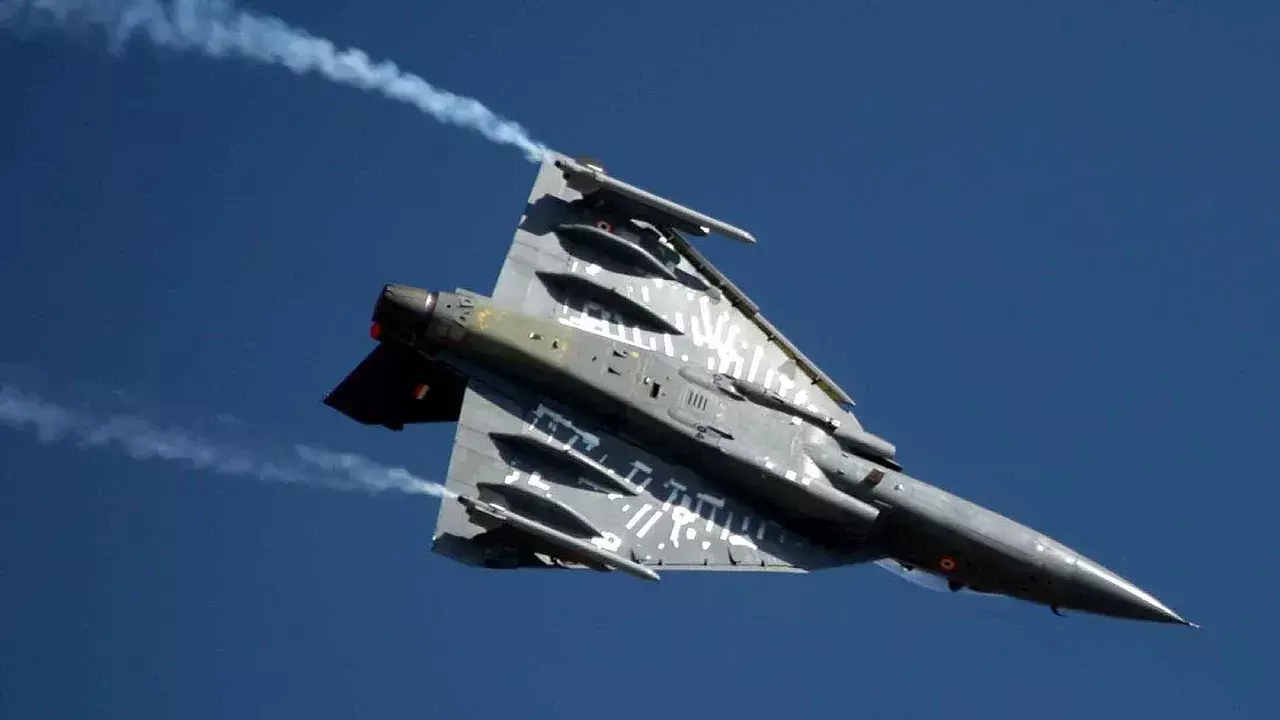
Tejas jet (PC- Social Media)
A Tejas fighter jet of the Indian Air Force suffered major airframe damage after it overshot the runway at a frontline airbase due to suspected brake failure. The pilot ejected safely. After the incident on February 7, the IAF grounded around 30 single-seat Tejas jets for technical checks. There has been no detailed official statement yet.
What Happened at the Airbase?
The incident took place earlier this month when a Tejas light combat aircraft was returning from a routine training sortie. While landing, the jet reportedly faced a suspected brake failure. It overshot the runway and sustained serious structural damage to its airframe.
Sources confirmed that the pilot acted quickly and ejected safely. That decision likely prevented a far worse situation. There were no reports of loss of life.
Interestingly, the Indian Air Force has not issued a detailed public statement about the February 7 accident. The silence has raised questions, though internal reviews are clearly underway.
IAF Grounds Entire Tejas Fleet
Soon after the accident, the Indian Air Force grounded its entire fleet of nearly 30 single-seat Tejas jets. This was done for extensive technical scrutiny. Such steps are standard after serious aviation incidents.
Grounding a fleet is not a small decision. It shows the matter is being taken very seriously. Engineers and safety teams are now examining systems, especially braking and landing mechanisms.
The goal is simple. Ensure no similar failure happens again.
Third Accident Involving Tejas
This is the third accident involving the Tejas aircraft in recent years. The first occurred in March 2024 near Jaisalmer, where a jet crashed during an operational mission. The second took place in November 2025 at the Dubai Airshow during an aerial display.
Now this February 2026 incident adds to growing concerns. Even though the pilot survived and the aircraft did not crash mid-air, airframe damage of this scale is significant.
Each event puts pressure on both the Air Force and the manufacturer.
Delays Add to the Pressure
The latest accident comes at a sensitive time. Hindustan Aeronautics Limited is already facing delays in delivering the Tejas Mk-1A variant. In 2021, the Defence Ministry signed a ₹48,000 crore deal with HAL for 83 Tejas Mk-1A jets.
Last year, another ₹62,370 crore contract was signed for 97 more jets.
But deliveries have not moved as planned. A major reason is delay in engine supplies from GE Aerospace. Without engines, aircraft production slows down. That reality cannot be ignored.
So when an accident happens in between these delays, scrutiny becomes even sharper.
Why Tejas Is Important for India
The Tejas is not just another fighter jet. It is India’s indigenous single-engine, multi-role combat aircraft. It is designed for air defence, strike missions, and even maritime reconnaissance.
For India, Tejas represents self-reliance in defence manufacturing. Every setback affects more than just operations. It affects confidence.
Still, aviation programs globally face challenges. Even advanced countries have similar hurdles during development phases.
What Happens Next?
Right now, the focus is on technical evaluation. Experts are checking braking systems, landing gear integrity, and overall structural strength. If the suspected brake failure is confirmed, corrective action will follow.
The grounded jets will likely return to service in phases, once cleared.
For now, the key relief is this. The pilot is safe. No civilian damage has been reported. The system responded quickly.
The coming weeks will reveal more clarity. Until then, the Tejas program remains under watch, but not under doubt.


