TRENDING TAGS :
When the Putin–Modi Summit Can Change Many Equations
The 2025 Putin–Modi summit may reshape India–Russia ties through key deals in energy, defence, nuclear power, trade, labour and media, boosting India’s strategic autonomy.
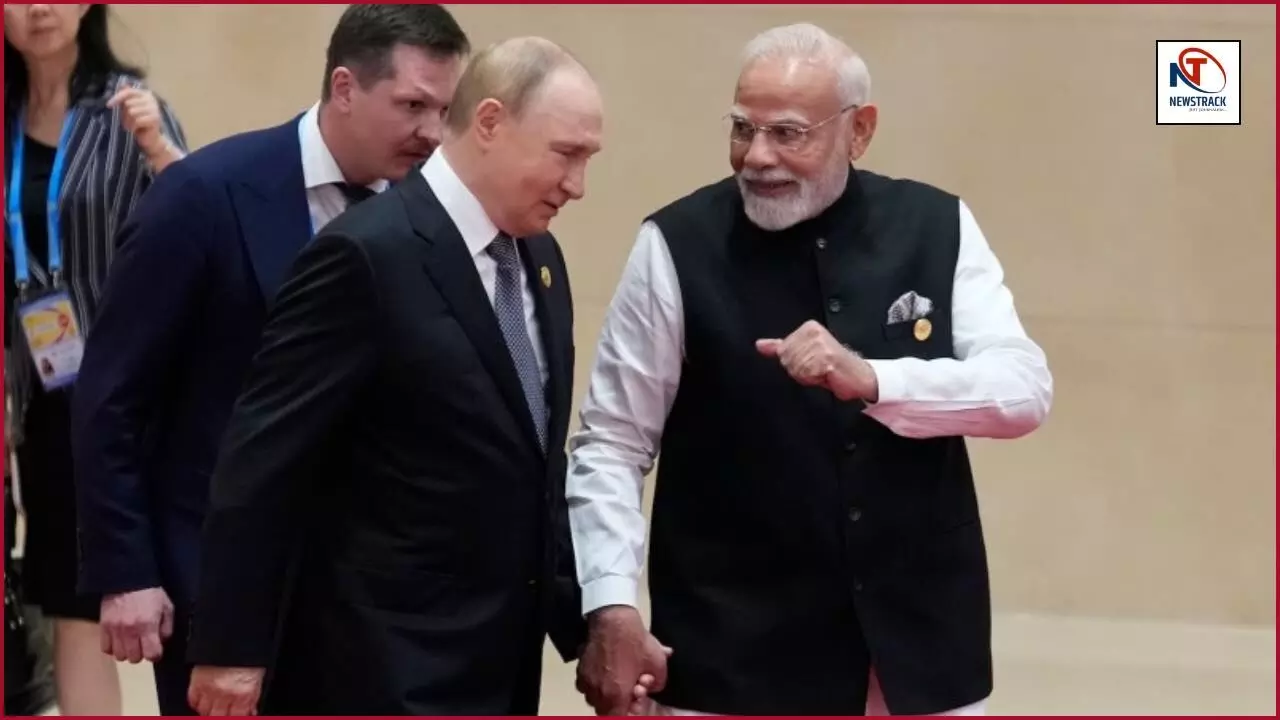
The story of India–Russia relations is hardly unknown to any Indian. Whether it was about supporting India against the US Seventh Fleet or the massive popularity of Raj Kapoor’s films in Russia—these references alone are enough to narrate the saga of India–Russia friendship.
In such a context, when Russian President Vladimir Putin arrives in India for a two-day visit on 4–5 December 2025, it is natural for a wave of expectations to rise. All the more because this is his first India visit after 2021, and also his first visit since the beginning of the Russia–Ukraine war.
Putin’s visit should not be seen merely as “one more annual summit”, but as a recalibration of India–Russia relations in a new post-war geopolitical reality. It is expected that around 10 inter-governmental agreements and nearly 15 commercial deals may be signed during this visit—focused on energy, defence, trade, technology, and media/soft power.
At the same time, if India succeeds in reducing the trade imbalance, deepening high-tech defence cooperation, and locking in long-term energy security through extended contracts, this visit could prove strategically very beneficial for India—and may give a new shape to the old “Indo–Soviet friendship model” according to the needs of the 21st century.
The sectors where inter-governmental and commercial agreements are likely include energy, defence, and nuclear power.
Affordable Russian Oil & Gas and Long-Term Energy Security • The largest component of India–Russia trade is now oil. In 2024–25, bilateral trade reached around $68.7 billion, of which nearly $63.8 billion consisted of Indian imports from Russia (primarily crude oil, fertilizers, coal). • Despite Western sanctions, Russia is still selling crude oil to India at relatively concessional rates. The aim during this visit is to move towards long-term supply contracts, resolve issues related to shipping and insurance, and make progress on local currency or alternative payment mechanisms so that supplies are not disrupted.
For India, the benefits would be: • Some relief in the energy import bill. • Supply diversification and reduced overdependence on West Asia. • Stronger long-term energy security.
For Russia, the advantage is that, despite sanctions, it gets a stable and large customer.
After BrahMos, Hypersonic Systems and S-400 – The Next Phase • During this visit, Indian media reports have confirmed discussions on advanced versions of BrahMos, including extended-range and higher-precision variants, as well as joint development of hypersonic weapon systems. • In the 2018 visit, a $5.43 billion S-400 deal was signed, and some systems have already been delivered. Current talks are expected to cover delivery timelines for remaining regiments, spares and maintenance, and possibly additional cooperation on air defence and fighter aircraft.
Expected Benefits for India • Stronger air defence and missile deterrence along the Pakistan–China front. • Greater self-reliance through joint R&D in high-end technology, including the next-generation versions of BrahMos.
The Story Beyond Kudankulam • Russia is already constructing reactors at the Kudankulam Nuclear Power Plant in Tamil Nadu; Units 1 and 2 are operational, and the roadmap for Units 3–4 and further units has been defined in earlier summits.
This time, the focus of discussions is expected to be: • Timelines of ongoing projects. • Joint construction at new sites. • Possible cooperation in Small Modular Reactors (SMR) and next-generation nuclear technologies.
The expected benefit for India: • Clean base-load power, enabling a gradual reduction in coal dependence. • Advancement in nuclear technology and opportunities for local manufacturing.
Trade, Investment and Payment Mechanisms • India–Russia trade has grown from roughly $13 billion in 2021 to $68 billion in 2024–25—more than a five-fold increase in four years. • However, this trade is heavily imbalanced. Russia’s surplus is around $58–59 billion.
In this visit, the focus will be on increasing Indian exports, particularly in: • Pharmaceuticals • Engineering goods • Auto components • IT services • Food products
There is hope that some pathway towards rupee–ruble or third-currency settlement will emerge. Strengthening of banking channels (such as the Indian presence of Sberbank/VTB) will also be discussed, along with the possibility of moving forward on a Free Trade Agreement with the Eurasian Economic Union (EAEU).
For India, the benefits may include: • New market space for “Make in India” products in Russia. • A reduction in dollar dependence. • Concrete efforts to make India–Russia trade more balanced.
Human Resources and a ‘Labour Corridor’ • Due to the Ukraine war and a broader demographic crisis, Russia is facing a shortage of skilled workforce. In recent months, indications have emerged that Russia is looking at Indian workers in sectors like IT, construction and healthcare. • A framework on this issue may be worked out during Putin’s visit.
Expected advantages for India: • New overseas employment markets for Indian youth. • Both remittances and skill upgradation.
Geopolitical Gains: Strengthening Strategic Autonomy • During this visit, India is likely to reiterate its message that the Russia–Ukraine war should be resolved through “dialogue and diplomacy”, while simultaneously strengthening its longstanding, trusted partnership with Russia. • This allows India to signal that it will continue its multi-alignment policy—maintaining parallel relationships with the West (US–Europe), Russia, and the Indo-Pacific (Quad).
This visit is taking place in the global context of the Russia–Ukraine war and Western sanctions. • Since 2022, heavy Western sanctions have targeted Russia. • India has increased its imports of Russian oil to serve its own interests. • However, due to shipping–insurance issues and secondary sanctions, Russian oil imports to India are expected to fall to a three-year low by December 2025.
India–Russia trade stands at $68.7 billion, but Indian exports are only about $4.9 billion, while imports are around $63.8 billion—a very large deficit.
With the return of the Trump administration in the US and its new tariff policies, India is facing pressure in some sectors. In such a situation, deepening economic ties with Russia can become a tool of risk diversification for India. On the other hand, Russia–China proximity has grown. India will seek to ensure that the Russia–China axis does not weaken India–Russia defence cooperation.
Likely Key Agreements in the Present Visit
1. Defence and Security • R&D MoU on advanced BrahMos and hypersonic systems. • Roadmap for delivery and maintenance under the ongoing S-400 deal. • Possible operational expansion of existing Reciprocal Logistics Support or similar military logistics agreements.
2. Energy • Long-term supply contracts for crude oil and gas, and roadmaps for cooperation in LNG, coal, and new energy sources (such as hydrogen).
3. Nuclear and High-Tech • Framework for the next units at Kudankulam, new nuclear sites, and SMRs. • Creation of joint working groups in space, AI, quantum technologies, and cyber security.
4. Trade, Investment and Payment Systems • Banking MoUs to increase trade in national currencies (such as rupee/ruble). • Discussion on special trade corridors or industrial parks for IT, pharma, auto components and agricultural products.
5. Labour and Education • A framework for employing skilled Indian workers in Russia, and for student exchanges/dual-degree programmes.
6. Media and Soft Power • With the launch of RT’s (Russia Today) Indian channel, Russian media presence in India will increase. This will be a part of “narrative diplomacy”.
Time-Tested Friendship • In the 1950s–70s, the Soviet Union vetoed several UN resolutions against India on the Kashmir issue. • In 1971, during the Bangladesh Liberation War, India and the USSR signed the Treaty of Peace, Friendship and Cooperation (9 August 1971), which strengthened the foundations of security, defence and economic cooperation. This period is often called the “Golden Phase” of India–Soviet relations. • After the dissolution of the Soviet Union in the 1990s, India–Russia relations continued. In 1993, a new Treaty of Friendship and Cooperation was signed. • In October 2000, Putin came to India for the first time as President. In this visit, the “India–Russia Strategic Partnership Declaration” was signed, elevating the relationship to the level of a strategic partnership. Eventually, this evolved into a “Special & Privileged Strategic Partnership”, which remains the official framework of India–Russia relations today.
Economic Relations: Old Friendship, New Trade Realities
Before the pandemic, in 2020–21, bilateral trade was only around $10–13 billion. After 2021—especially during the Russia–Ukraine war—India began importing Russian oil in large quantities, pushing trade to $68.7 billion in 2024–25. However, this increase has been mostly one-sided in Russia’s favour, leading to a significant trade imbalance.
Defence–Strategic Cooperation: Key Lines • Nearly 50–60% of India’s major military platforms (Su-30MKI, T-90 tanks, MiG aircraft, several submarines and helicopters) are of Soviet/Russian origin. • The India–Russia joint venture on BrahMos has produced one of the world’s fastest supersonic cruise missiles, which is now moving towards advanced and hypersonic variants. • Kudankulam is India’s largest nuclear power project, implemented with Russian assistance, and additional reactors have also been agreed upon. • The five-regiment S-400 deal worth about $5.43 billion gives India a decisive edge in air defence.
When Has Putin Visited India, and What Key Agreements Were Signed?
According to Indian media and official documents, including the 2025 visit, this is considered Putin’s 11th visit to India (he has also visited once as Prime Minister). 1. October 2000 – First visit as President • Destinations: New Delhi and Agra. • Main outcome: Signing of the “Declaration on the India–Russia Strategic Partnership”, granting the relationship an official strategic partnership status. • Impact: Established the tradition of annual summits and created a stable framework for defence, energy and space cooperation. 2. Second visit – December 2002 • The “Delhi Declaration on Further Consolidation of Strategic Partnership” was announced. • Joint agreements on economic, scientific and technological cooperation were signed. • Both sides pledged to cooperate against terrorism and to work together in defence production, energy and space. 3. Third visit – December 2004 (Annual Summit) • Roadmaps were set for defence and nuclear energy cooperation, along with trade expansion targets. 4. Fourth visit – January 2007 (Summit visit) • Reaffirmation of the strategic partnership. • Several MoUs in defence, energy and space cooperation were concluded. 5. Fifth visit – March 2010 (as Prime Minister of Russia) • Main focus: Energy cooperation and nuclear energy. • A roadmap for Kudankulam Units 3–4 was finalized. 6. Sixth visit – December 2012 (13th Annual Summit) • Joint statement titled “Partnership for Mutual Benefit and a Better World” issued. • Agreement on the progress of Kudankulam Unit 1, expediting work on Unit 2, and finalizing the framework for Units 3–4. 7. Seventh visit – December 2014 (15th India–Russia Summit) • Multiple agreements on an energy package, hydrocarbons and the defence industry, emphasizing joint production and technology transfer. 8. Eighth visit – October 2018 (19th Summit) • One of the most high-profile visits. • Key feature: Signing of the S-400 air defence system deal (worth $5.43 billion). • Several MoUs on space, railways, nuclear energy, trade and investment. 9. Ninth visit – December 2021 (21st Summit, just before the Ukraine war) • Agreement on the production of AK-203 assault rifles in India, to be manufactured at the Amethi plant. • Signing of the Military–Technical Cooperation Programme for 2021–2031. • Multiple agreements on defence, energy and cyber security. 10. This is the tenth summit visit • This period is marked by the Ukraine war, Western sanctions, increased oil trade, and a persistent trade imbalance. • Around 10 inter-governmental agreements and 15 commercial deals are expected, with focus areas including energy, defence (BrahMos–hypersonic systems), nuclear power, IT, payment systems, and labour cooperation, along with expanded media presence via the RT channel launch.
India–Russia Relations: Present and Future
From a strategic perspective, Russia remains one of India’s most reliable sources of affordable energy, high-end defence technology and nuclear power. For an India that seeks to balance between China and the West, strong relations with Russia are essential for strategic autonomy.
From an economic perspective, despite a record $68+ billion trade volume, the trade deficit remains a major concern for India. One measure of this visit’s success will be how much progress India can make on boosting exports and on rupee/ruble settlement mechanisms.
Projects like BrahMos, S-400 and Kudankulam show that India–Russia cooperation is not just about “buying and selling”, but about joint development and technology sharing. If a concrete roadmap for hypersonic systems and new-generation missiles/platforms is truly achieved, India’s long-term military–technical capabilities will receive a significant boost.
Diplomatically, Putin’s visit to India during wartime, and Prime Minister Modi hosting him for a private dinner, sends a clear signal that despite Western pressure, the core of India–Russia relations remains strong and backed by political will.
The Challenges • Amid the emerging Russia–China–Iran equations, India must ensure that Russia’s strategic priorities do not turn against Indian security interests. • At the same time, balancing expanding economic–technology ties with the West and traditional defence–energy partnerships with Russia will not be easy.