TRENDING TAGS :
A Temple Where Lord Ram Is Worshipped as a King
Ram Raja Temple in Orchha is the world’s only shrine where Lord Ram is worshipped as a king. Explore its legend, history, architecture, rituals, and cultural legacy.

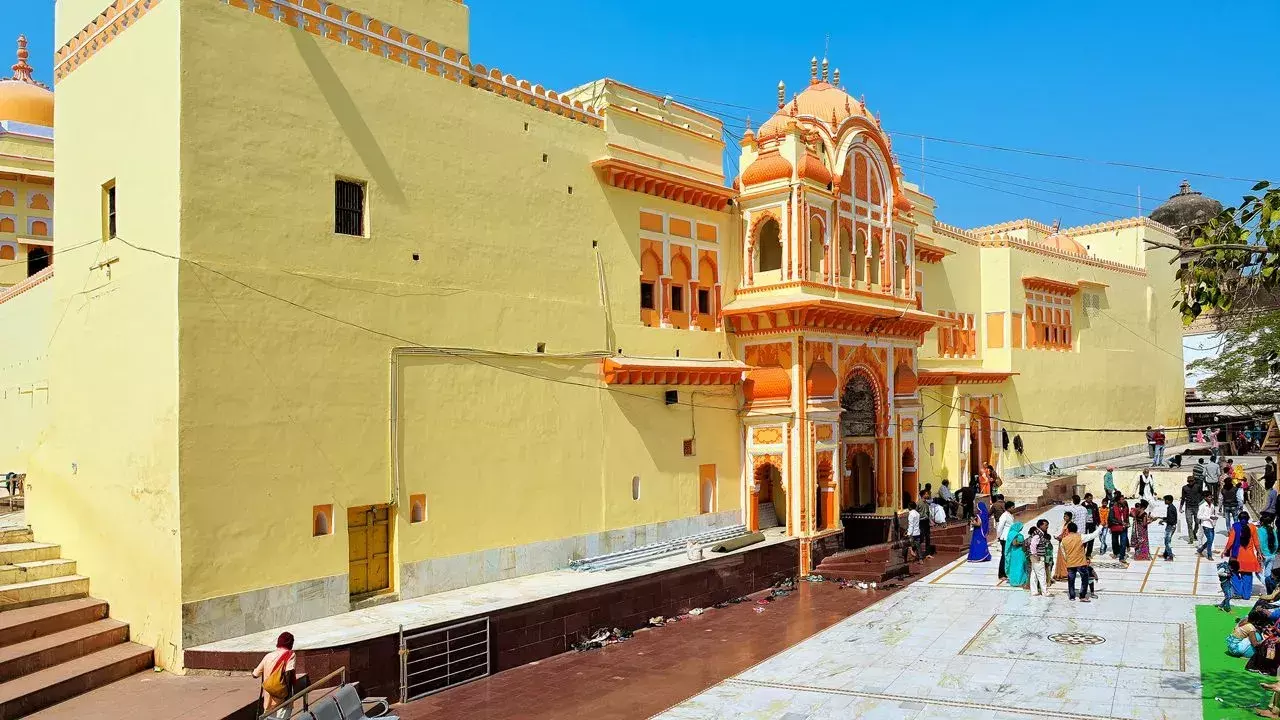
Ram Raja Temple in Orchha (PC- Social Media)
Orchha, a small town situated along the Betwa River in the Bundelkhand region of Madhya Pradesh, is world-renowned for its rich historical and religious heritage. The greatest attraction of this town is the Ram Raja Temple—a sacred shrine where Lord Ram is worshipped not only as God but also as a King. This is the only temple in the world where Shri Ram receives full royal honour. The temple’s distinctive architecture, mythological legends, and regal traditions make it an incredibly special and unique pilgrimage site.
The Origin of the Ram Raja Temple
The story of the Ram Raja Temple begins in the 16th century when Orchha served as the capital of the Bundela dynasty. This temple is famous for its extraordinary legend involving King Madhukar Shah and his queen, Ganesh Kunwari, whose devotion shaped its destiny.
Madhukar Shah was an ardent devotee of Lord Krishna, while Queen Ganesh Kunwari was the staunchest devotee of Lord Ram. Their differing spiritual inclinations often sparked debates between the king and the queen.
One day, in a tone of mockery, the king remarked that if the queen was truly such a great devotee, she should bring Lord Ram from Ayodhya to Orchha. The queen accepted the challenge with utmost seriousness and embarked on a pilgrimage to Ayodhya.
Upon reaching Ayodhya, she began intense penance on the banks of the Saryu River. After months without divine revelation, a disappointed queen decided to end her life by drowning in the Saryu. It is believed that the moment she leapt into the river, Lord Ram appeared in her arms in the form of a child.
The queen pleaded with him to accompany her to Orchha, and Lord Ram agreed—but only on three conditions:
1- Wherever he is seated, he would remain fixed at that spot. 2- Upon reaching Orchha, he alone would rule—the kingdom would belong to him. 3- He would travel to Orchha on foot, in his child form, under the Pushya Nakshatra, accompanied by sages and saints.
The queen accepted all three conditions and finally returned to Orchha with Lord Ram on Ram Navami in 1574.
Transformation of the Queen’s Palace into a Temple
Since the Chaturbhuj Temple was still under construction at that time, the queen installed Ram’s idol temporarily in the kitchen of her palace. But when the temple was completed and the idol was to be moved, it refused to shift. Interpreting this as a divine sign, King Madhukar Shah transformed that very palace into a temple.
Thus, the queen’s residence—Rani Mahal—became the Ram Raja Temple, the only temple where Lord Ram sits not in a sanctum, but in the kitchen of a palace, as a reigning king.
A famous couplet inscribed at the temple highlights this uniqueness:
“Ram Raja Sarkar ke do nivaas hain, Khaas divas Orchha rahat hain, rain Ayodhya vaas.”
This means Lord Ram rules Orchha during the day and returns to Ayodhya at night.
Architecture of the Ram Raja Temple
The architecture of the Ram Raja Temple is a beautiful example of Bundela style. Built from pink and yellow stones, it resembles a royal palace more than a traditional temple. The structure is simple yet majestic, with lofty domes, arched gateways, and expansive courtyards.
Inside the sanctum, Lord Ram is seated in Padmasana—holding a sword in his right hand and a shield in his left—symbolising his royal and warrior persona.
Surrounding the temple are several small shrines dedicated to Lord Hanuman—such as Chaddhari Hanuman, Bajaria Hanuman, and Lanka Hanuman—which together form a protective spiritual circle. The temple walls display exquisite paintings and carvings depicting scenes from the Ramayana.
Royal Protocol and Daily Rituals
The most extraordinary feature of the temple is its royal protocol. Here, Lord Ram receives the same honour as a living king.
Four daily aartis are performed:
• Morning Aarti at 8:00 AM • Rajbhog Aarti at 12:30 PM • Evening Aarti at 8:00 PM • Shayan Aarti at 10:30 PM
During each aarti, the Madhya Pradesh Police presents an armed Guard of Honour—a tradition nearly 500 years old, initiated by King Madhukar Shah himself.
Even the Prime Minister or the President of India does not receive such honour.
Lord Ram is offered royal meals, fragrances, and paan—reflecting the practices of a sovereign ruler.
Cultural Harmony and Significance
The temple’s religious and cultural significance is immense. People from both Hindu and Muslim communities worship Lord Ram here, reflecting Orchha’s harmonious Ganga–Jamuni culture.
Locals like Munna Khan and Naeem Beg often say that in Orchha, Ram is above religion—he belongs to everyone. For any auspicious occasion, the first invitation card is sent to Lord Ram.
Throughout the year, the temple is filled with devotees. During Ram Navami, Makar Sankranti, Vasant Panchami, Shivratri, Kartik Purnima, and Vivah Panchami, the crowds surge into the thousands. Every year, nearly 6.5 lakh domestic and 25,000 foreign tourists visit the site.
Legends and Myths Surrounding the Temple
Many legends add mystery to the temple’s aura. It is said that during the foreign invasions in the 16th century, saints immersed the idol of Ram Lalla in the Saryu River for protection—and the same idol was found by Queen Ganesh Kunwari. Another legend suggests that Lord Ram appeared in King Madhukar Shah’s dreams and ordered him to bring the queen back. Some even claim that the Ramcharitmanas was completed by Tulsidas in the same era, coinciding with Ram’s arrival in Orchha.
Orchha’s Other Marvels
Along with the temple, Orchha is home to:
• Chaturbhuj Temple • Jahangir Mahal • Lakshmi Narayan Temple • Rai Praveen Mahal • Cenotaphs along the Betwa River
Chaturbhuj Temple—originally built for Ram—remains vacant but continues to awe visitors with its grandeur. Jahangir Mahal is renowned for its fusion of Mughal and Bundela architecture.
Lakshmi Narayan Temple is known for its rare paintings and complex patterns. Rai Praveen Mahal stands as a symbol of artistic grace. Hardaul’s Baithak and Samadhi carry historical importance. The cenotaphs preserve the memory of Bundela kings.
Cultural Fabric and Spiritual Atmosphere
The socio-cultural environment of Orchha is one of its strongest attractions. Its Ganga–Jamuni harmony, tranquil spiritual atmosphere, and natural beauty offer peace to every visitor. During Ram Navami, celebrations become magnificently grand.
Conclusion
The Ram Raja Temple is the heartbeat of Orchha. It is not merely a religious shrine, but a symbol of Indian culture, history, and faith. The tradition of worshipping Lord Ram as a king, the divine legends, and the regal rituals make it the most distinctive temple in the world.
Whether one visits as a devotee, a history enthusiast, or an admirer of architecture—Ram Raja Temple and Orchha together offer an unforgettable experience.