TRENDING TAGS :
Five-Storey Palace Floating on Water: A Marvel of Wonder
Jal Mahal is a five-storey palace floating in Jaipur’s Man Sagar Lake, known for its unique submerged architecture, royal history, mysteries, and breathtaking beauty.

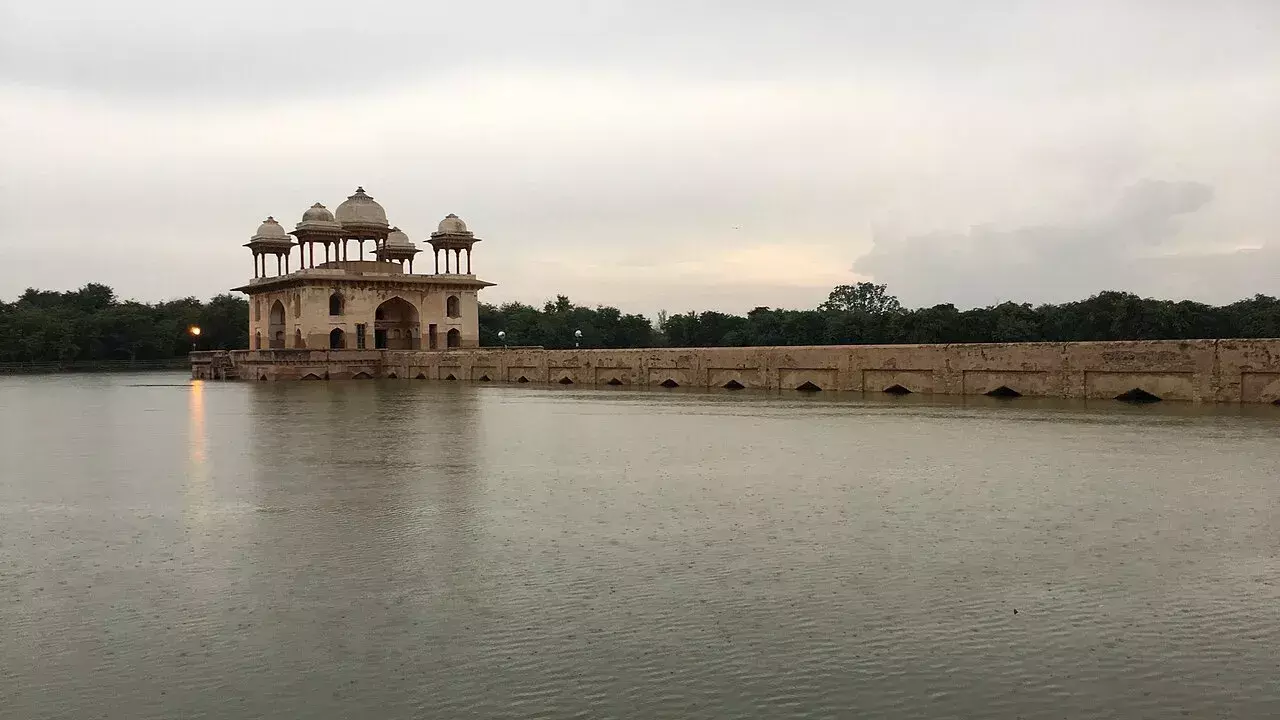
Jal Mahal (PC- Social Media)
Jal Mahal, located in the middle of Man Sagar Lake in Jaipur, is a priceless treasure of Rajasthan’s cultural and historical heritage. Situated in the famous Pink City, this palace is globally admired for its unique architecture and stunning beauty. Nestled in the lap of the Aravalli hills, the palace is lovingly called the “Eyeball Palace” and the “Romantic Palace.” It is not just a building, but a rare confluence of history, architecture, and nature.
True to its name, the palace is a royal structure built right in the middle of the water. It is located on the Jaipur–Amer route, precisely at the centre of Man Sagar Lake. Although its foundation was laid in 1699, its present form was built in the early 18th century by Maharaja Sawai Jai Singh II, the founder of Jaipur city.
Sawai Jai Singh built Jal Mahal for specific purposes—it was not only a retreat for spending time with the queens but also a venue for royal celebrations, religious rituals, and especially the performance of the Ashvamedha Yajna. According to some historians, the palace was also designed as a royal bathing place for the queens, offering complete privacy and grandeur.
Man Sagar Lake itself was created under the supervision of Sawai Jai Singh. To solve Jaipur’s water supply problem, he built a dam on the Dharbawati (formerly called Garbhavati) river, resulting in the formation of this vast lake. Afterwards, Jal Mahal was constructed in the middle of the lake, which even today is famous for its strength and captivating charm. This nearly 300-year-old palace appears as though a magical royal structure is floating upon the water.
The palace’s architecture makes it one of the most unique palaces in India. It is a five-storey structure, but its most astonishing fact is that four of its storeys remain submerged under water, and only the top storey is visible.
This extraordinary design not only makes it visually spectacular but also extremely functional—because the submerged floors keep the interiors naturally cool. In the scorching heat of Rajasthan, this palace is considered a marvel of architectural innovation.
The structure is built from red sandstone, symbolizing the traditional architecture of Rajasthan. Lime plaster was used to strengthen the walls, preventing water seepage. This technique stands as a remarkable example of the engineering capabilities of that era—because even after centuries, the palace has remained unaffected by the surrounding water.
The architecture showcases a fine blend of Rajput and Mughal styles. The arches, chhatris, and bastions reflect Rajputana influence, while the window and roof designs reveal Mughal artistic elegance. At all four corners of the palace stand octagonal chhatris, giving it a symmetrical and regal appearance.
The palace roof has a beautiful terrace garden known as Chameli Bagh. Decorated with arched corridors, this garden once bloomed with fragrant flowers and served as a romantic retreat for the king and queens.
Since Jal Mahal was not designed as a permanent residence but as a leisure retreat, it features open halls and long corridors instead of private chambers. Sawai Jai Singh and his queens would arrive here by boat. The palace served as their secluded, peaceful sanctuary amidst nature. On moonlit nights, the reflection of the palace shimmering in the lake waters appears so enchanting that it resembles a fantasy world.
Today, Jal Mahal is protected as a heritage site by the government, due to which entry inside the palace is restricted. Still, visitors can admire its grandeur from the lakeside and capture the breathtaking view through photography.
While the beauty of Jal Mahal is mesmerising, some mysterious beliefs make it even more fascinating. Locals and some tourists believe the palace is haunted. They claim that strange noises and shadows appear in its corridors at night. Some even list it among Rajasthan’s haunted spots. Although there is no scientific evidence for these claims, the mystery enhances the palace’s allure.
The fact that four entire storeys lie underwater is itself a matter of intrigue. People often wonder what lies within those submerged levels and how they were constructed.
Historians believe that the underwater chambers of Jal Mahal once housed frescoes, special arches, and even secret passages—many of which are no longer visible due to rising water levels. Several experts state that the palace’s foundation was built using a unique “lime–surkhi mixture” so strong that the structure has remained firmly intact in the lake for 300 years—an extraordinary example of engineering brilliance from that era.