TRENDING TAGS :
Elections Are Won Not by Speeches, but by Structure: What Truly Determines Victory in India?
A deep analytical essay explaining how elections in India are actually won—beyond speeches and rallies—through caste dynamics, vote share, alliances, booth management, and organizational structure.

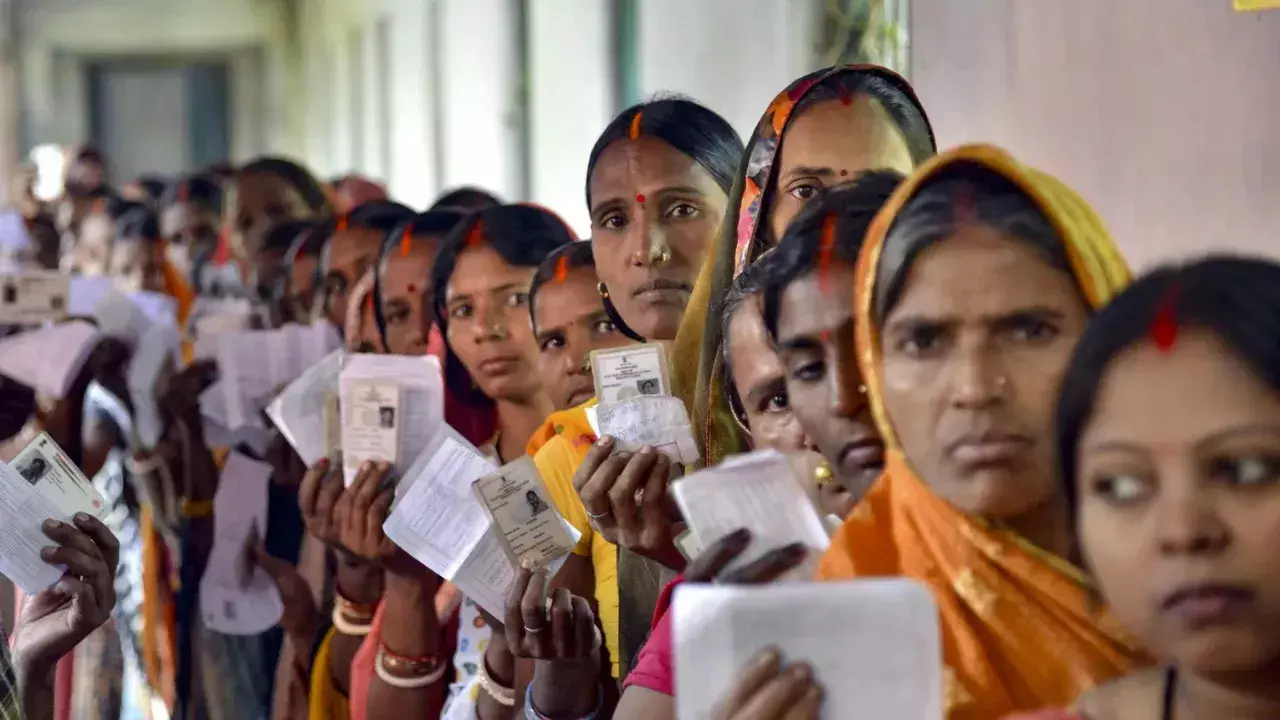
Bihar Vote (PC- Social Media)
At a superficial glance, Indian democracy often appears to be driven by grand speeches, emotional slogans, massive rallies, and the charged debates that dominate television screens. To the average observer, this is exactly what elections seem to be—leaders thundering from stages, crowds applauding in unison, clips going viral on social media, and news channels framing the atmosphere as a “wave” or a “mood.” Yet those who understand elections from within know that this picture is incomplete. Elections in India are not merely an outburst of public sentiment; they are the combined outcome of social structures, organization, numbers, resources, candidates, local equations, and the machinery of polling day. The entire electoral system, as designed by the Election Commission, is built upon the meticulous arrangement of polling stations, booth-level lists, logistics, training, security, and area-wise preparation well in advance. In other words, elections rest upon a microscopic structure—not upon slogans alone. The real battle of elections is fought quietly on the ground, far behind the noise.
The biggest myth is that “the larger the rally, the surer the victory.” This is one of the most popular yet most misleading beliefs in Indian elections. A rally displays crowds; it does not count votes. The crowd at any gathering arrives for many reasons—local curiosity, the charisma of a leader, organizational mobilization, caste loyalties, transportation arrangements, or sometimes mere spectacle-driven psychology. But whether that crowd converts into votes at the polling booth is never guaranteed. In Indian elections, the real question is not how large a crowd was gathered, but who succeeded in bringing their supporters out of their homes and into the polling booth on election day. The Election Commission’s own operational frameworks repeatedly emphasize booth-level preparation, voter lists, training, identification of sensitive centers, and micro-planning for polling day. This makes one thing clear—an election is not a one-day spectacle; it is the result of months of structured preparation.
The second major myth is that “elections in India are decided purely by caste.” This statement is dangerous precisely because it is half true. It is true that caste remains an important socio-organizational factor in Indian politics. Long-term electoral studies by institutions like Lokniti-CSDS have consistently shown that caste and religion play a central role in shaping voting behavior. But it is not the entire truth that caste alone determines outcomes. Caste provides a base; it does not decide the final result. Even in constituencies with favorable caste arithmetic, a wrong candidate, weak organization, divided vote, poor alliance strategy, local dissatisfaction, or weak booth management can lead to defeat. Conversely, even in unfavorable social equations, a strong candidate, credible image, smart alliances, division of opposition votes, and superior micro-management can deliver victory. Therefore, caste is a pillar of elections—but not the entire structure.
The third myth suggests that “the most liked candidate always wins.” This sounds morally appealing in a democracy, but the electoral mathematics of India is far more complex. Most Indian elections operate under the ‘first-past-the-post’ system, meaning that the candidate with the highest number of votes wins—even if they do not secure an absolute majority. This implies that elections are often won not by majority, but by relative advantage. Sometimes even 30 to 40 percent of votes are sufficient, especially when the opposition is fragmented. This is where the game of vote share begins. Smart political parties do not merely assess how many votes they have; they analyze how the opposition’s vote is divided, which social group is leaning where, and where a swing of just 2–3 percent can flip an entire seat. That is why election strategists pay closer attention to decimal points in vote share than to lines in speeches. Victory emerges not from a vague sense of popularity, but from the structure of votes.
The fourth myth claims that “good speeches, strong media presence, and social media trends win elections.” This, too, is an incomplete truth. Speeches can shape the narrative, energize supporters, pressure opponents, and provide visibility in media. But a vast and diverse society like India cannot be governed from television studios alone. Surveys by Lokniti-CSDS studying sources of electoral decision-making show that local conditions, employment issues, dissatisfaction, community influence, candidate credibility, and last-minute interactions all significantly impact voter decisions. In other words, national narratives matter—but they translate into votes only after interacting with local social realities. A leader who speaks only for the camera but fails to build organization on the ground often creates noise—but not victory.
The fifth myth is perhaps the most intriguing—“a clean and honest candidate automatically wins.” Democratic ideals may suggest so, but electoral reality in India is far more complex. According to the 2024 Lok Sabha analysis by ADR, candidates with declared criminal cases had a significantly higher success rate compared to those with clean backgrounds. The winning rate for candidates with declared criminal cases was 15.3 percent, while it was only 4.4 percent for those without such cases. Similarly, financial strength has also proven decisive, with wealthier candidates often enjoying an advantage. This does not mean that voters prefer crime or wealth; rather, factors such as local influence, resource capacity, campaign strength, networks, fear, loyalty, and the perception of “winnability” combine to produce such outcomes. Thus, electoral morality and electoral success are not always direct reflections of each other. This is perhaps the most uncomfortable—and yet the most real—truth of Indian politics.
The real question, then, is what truly determines electoral victory. The answer lies not in a single formula, but in three interconnected layers. The first is social arithmetic—understanding which communities are decisive, which are dissatisfied, which are loyal, and which are floating voters. The second is political arithmetic—alliances, candidate acceptability, the balance between local and national issues, and the division of opposition votes. The third is organizational arithmetic—how active the booth committees are, how well voter lists are understood, which supporters will actually come out to vote, who needs to be contacted in the final hours, where transport must be arranged, which booth has a strong agent, and which polling station is considered difficult. Election Commission manuals themselves demonstrate how deeply detailed election management is at the booth level; this is why political parties fight their real battles at booths, not on stages.
Another myth suggests that “if there is a wave, everything else becomes irrelevant.” This, too, is not entirely accurate. Waves do exist, but they do not operate uniformly across all constituencies. A national wave may influence dozens or even hundreds of seats, but candidate image, local dissatisfaction, caste dynamics, alliance intricacies, and booth-level organization can amplify or reduce its impact. A wave can make elections easier—but it cannot win them on its own. Only the party that combines a wave with organization can convert it into seats. Otherwise, a mood may exist—but seats may not follow.
Because a rally crowd is not a vote—it is merely a number. People attend rallies under organizational pressure, curiosity, social affiliation, or even compulsion. Applause in speeches does not convert into seats, and social media trends do not appear inside EVMs. The real game of elections begins the moment a voter steps out of the house and walks toward the polling booth.
Therefore, the most honest and accurate explanation of Indian elections is this: they are not determined solely by caste, nor by speeches, nor by money, nor by issues, nor by waves. They are the combination of all these elements—but the controlling force is organization and structure. Speeches influence the voter, caste frames the context, issues provide moral reasoning, the candidate gives a face, alliances provide direction—but ultimately, booth management converts all of this into votes. The party that understands this chain wins elections. The party that fights elections only on television often wins only on television—not on the ground.
And in the end, this is both the greatest irony and the greatest truth of democracy—only a single button is pressed on the ballot, but behind that one act lies an entire machinery of society, strategy, organization, resources, psychology, and mathematics. In democracy, the vote is visible—but victory is determined by the structure behind it. Elections are not won by noise, but by coordination; not by faces, but by silent preparation; not by speeches, but by the arithmetic that converts crowds into votes—and votes into seats.
(The author is a journalist.)