
TRENDING TAGS :
Is India on the Right Path? Dr. Joshi Raises the Issue

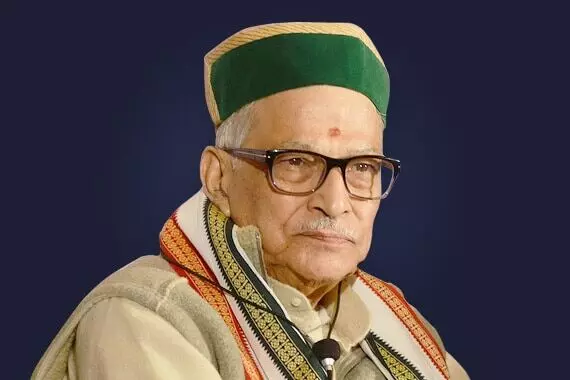
Senior thinker and former Union Minister Dr. Murli Manohar Joshi has emphasized the need for serious reflection on India’s economic and strategic future. Speaking at a recent meeting of an economic group, Dr. Joshi elaborated on issues such as India’s energy security, technological self-reliance, and intellectual independence.
He said that if India truly wants to become a powerful and self-reliant nation, it must achieve complete energy sovereignty. According to him, energy is not merely a means of economic development but the foundation of a nation’s political, economic, and strategic independence. During the meeting, he discussed several topics in detail, including global politics, artificial intelligence, the energy crisis, and the role of nuclear energy.
Dr. Joshi said that the world is changing rapidly and India must think not from a limited perspective but from a broader global viewpoint. Referring to the current situation in the Middle East particularly Iran’s nuclear program and the international tensions surrounding it he said that in the modern world, control over technology and energy resources has become the real basis of power. He stressed that India must examine whether it is moving in the right direction in accordance with its own ideology and principles.
Energy: The Foundation of Development
Dr. Joshi said that no activity is possible without energy; every aspect of society depends on it. He noted that India aims to become a developed country, but there is a need to seriously reflect on what the true meaning of a “developed nation” actually is.
Today the concept of “net zero” is widely discussed globally, meaning energy should be used in a way that minimizes pollution and ensures balanced use of resources. Dr. Joshi said that this idea has long existed within the Indian way of life. Traditionally, Indian society made full use of resources and minimized wastage. He pointed out that coal still accounts for the largest share of India’s energy mix, which poses environmental challenges. Although renewable energy options exist, they also come with limitations and technological challenges. For example, solar energy could eventually create problems such as the disposal of solar panel waste.
Energy Self-Reliance is Essential
Dr. Joshi said energy self-reliance is extremely important for any nation. If a country depends on others for its energy needs, its strategic independence becomes limited. According to him, India does not lack talent, resources, or capability, but achieving the goal requires a long-term and well-defined policy. If India truly wants to become a highly developed nation, it must formulate a solid and self-reliant long-term strategy in the energy sector. He also noted that if India aims to become a developed nation by 2047, energy demand will increase rapidly. Currently, India’s annual energy consumption is about 6,500 terawatt-hours, but to reach the level of developed countries it may need to rise to nearly 28,000 terawatt-hours. In this context, Dr. Joshi referred to Dr. Homi Jehangir Bhabha, the architect of India’s nuclear program. In 1952, Dr. Bhabha had said that if nuclear energy could be successfully used for electricity generation, India would not need to depend on foreign experts within a few decades. Dr. Joshi recalled an incident in which he once asked Dr. Bhabha whether the program could ensure electricity for every village in the country. Bhabha reportedly replied that if the program succeeded, electricity could be supplied at a cost of five paise per unit.
Small Modular Reactors Could Be a Solution
Dr. Joshi suggested that small modular reactors (SMRs) could be a suitable option for India’s energy future. These are compact nuclear reactors that can be installed near cities or smaller regions. They offer high safety standards, lower radiation risks, and comparatively smaller environmental impacts. He explained that such reactors can generate around 300 to 500 megawatts of electricity and could become an important step toward energy self-reliance.
Slogans Alone Will Not Work
Dr. Joshi said India has the potential not just to become a developed nation but a highly advanced global power. However, this cannot be achieved through slogans alone; it requires serious and concrete thinking. He noted that in today’s world, major powers attempt to control the global order through technology and capital. Countries like China and the United States possess both and are influencing the global system. He warned that if a nation lacks its own technology, both its political and economic sovereignty may come under threat.
Concerns Over AI and Intellectual Freedom
Dr. Joshi also expressed serious concerns about artificial intelligence (AI). He said digital technologies and data could be used to control people’s thinking and knowledge. If information disappears from digital platforms, future generations might not even know about their own history and culture. Referring to renowned scientist Geoffrey Hinton, he said the uncontrolled development of AI could pose serious challenges for humanity. According to Dr. Joshi, while technological progress is necessary, protecting humanity and intellectual freedom is equally important.
India’s Wider Influence
In his speech, Dr. Joshi also spoke about India’s historical influence across the world. He said that if one looks at the world map, India’s position becomes very clear. China lies to the north, and moving southward one reaches Indonesia. This entire region was once influenced by Indian ideas and cultural traditions. It includes areas such as Myanmar, Malaysia, Cambodia, Laos, Singapore, and Indonesia. In Indian literature, Indonesia is referred to as “Dweepantar,” meaning the island beyond India. Looking westward, Pakistan and above it Iran can be seen. Iran, too, is significant from a civilizational perspective. Its ancient name was Aryan, and many elements of its religious traditions and the Avesta text resemble concepts found in the Vedas. Even today, several similarities between Iranian and Indian culture can be observed. Thus, this entire region has historically been connected with Indian influence in various ways—culturally, politically, and geographically.
Further west lies the region now called the Middle East, where Israel is located, and which has become an area of concern today. Along with Iran, neighboring countries such as Iraq and Syria are also part of this region. In ancient times, this area was known as Babylonia, and traces of Indian cultural influence can also be found there.
Dr. Joshi noted that Iran possesses reserves of uranium, an element crucial for both nuclear energy and nuclear weapons. This is why Western countries, as well as China, Russia, and especially Pakistan, have been concerned about Iran acquiring nuclear technology. If Iran were to obtain such technology, it could become a very powerful country in the region.


