TRENDING TAGS :
More Than a Political Bond: The Story of Kanshi Ram and Mayawati’s Shared Mission
The inspiring story of Kanshi Ram and Mayawati — a bond beyond politics, rooted in purpose, equality, and the shared mission of empowering India’s Bahujan community.

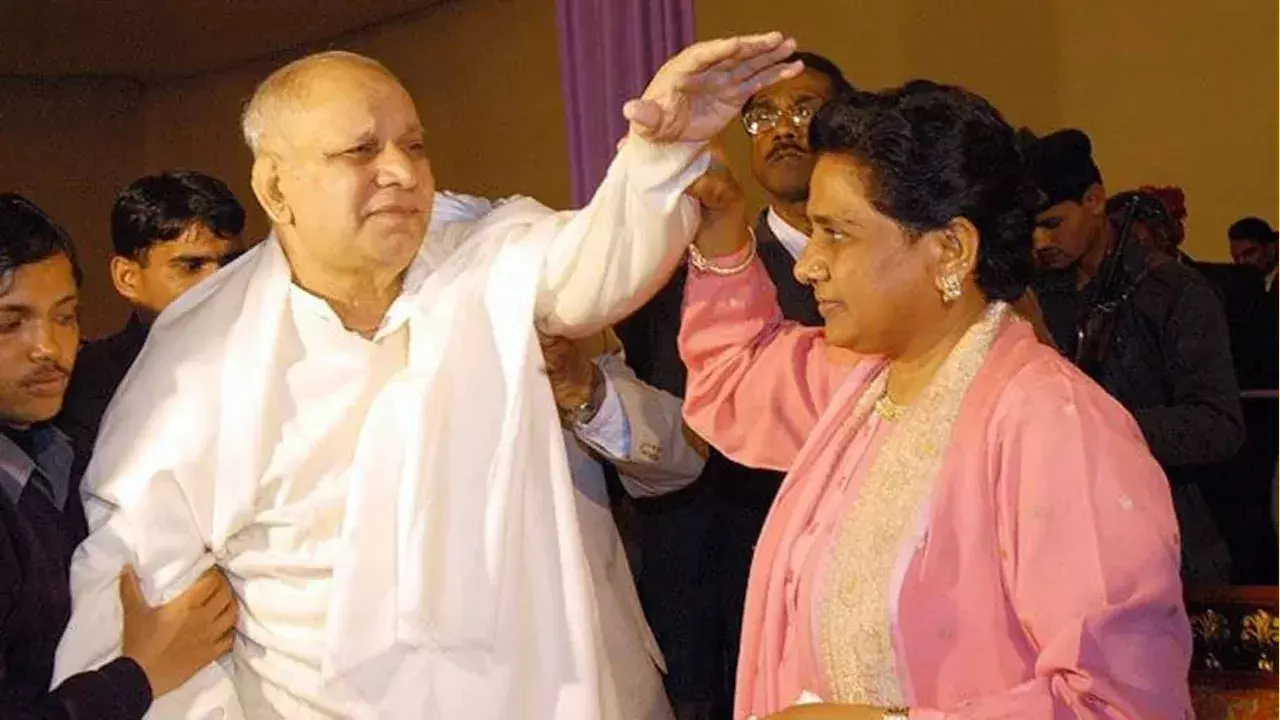
Kanshi Ram and Mayawati (PC- Social Media)
It was not a routine introduction
That meeting in 1977 between a young teacher from a Delhi neighborhood and a towering Dalit thinker was neither rehearsed nor foreseen. But it marked the beginning of one of India’s most transformative political journeys.
She was preparing for the civil services; he was preparing an army of social reformers. She sought a government job; he sought a revolution. But when Kanshi Ram met Mayawati, something changed — for both of them, and eventually, for Indian politics.
A Partnership Rooted in Purpose
Kanshi Ram didn’t just spot potential in Mayawati. He recognized in her the same fire he had spent years fanning within himself — the fire of frustration, the anger of generations, the refusal to remain unheard. She wasn’t merely articulate; she was audacious. Not merely literate; but prepared. Not a follower; but someone capable of leading.
For Mayawati, Kanshi Ram was more than a mentor. He was her compass — the man who gave shape, structure, and significance to her sense of injustice. He didn’t just give her a party; he gave her a role in history.
Kanshi Ram often said: “I have given Mayawati to the people. From now on, she and this society own my life.”
This wasn’t rhetoric. It was a handover of responsibility — not of power, but of purpose.
He trained her not as a woman in politics, but as a steward of the Bahujan ideology — one who could hold a mic and shake a system, one who would walk into Parliament, not as a token, but as a force.
Beyond Blood, Beyond Convention
Their relationship was many things — But never reducible to labels. It wasn’t familial. It wasn’t romantic. It wasn’t transactional.
It was mission-driven.
Mayawati never married. Kanshi Ram never built a family. Instead, both dedicated their lives to the political liberation of India’s most oppressed. Their shared life was not lived in the privacy of companionship, but in the public glare of resistance.
When Kanshi Ram fell ill, Mayawati became his caregiver. Not out of sentiment, but out of duty. Not as a niece, not as a nurse — but as someone carrying forward his unfinished task. She was there until his last breath.
His last words to her were not personal — they were political: “Now this movement is yours. It’s your responsibility to carry it forward.”
No legal will. No grand ceremony. Just one sentence — that defined her for the rest of her life.
Inheriting a Movement, Not a Throne
When Mayawati became Chief Minister of Uttar Pradesh, she installed not only her own statue but Kanshi Ram’s beside it. For her, that wasn’t a gesture of ego — it was a gesture of continuity. For critics, it was political theater. For her, it was the completion of a sentence Kanshi Ram had begun.
Time and again, she has said: “Had Kanshi Ram not found me, I would not be who I am today. He gave me purpose, and I am still walking the path he set before me.”
And she did walk it — Through victories, through humiliations, through electoral wipeouts and sweeping mandates. But every decision she took, every alliance she made, every silence she kept — all of it circled back to one question: “Would he have approved?”
The Quiet That Politics Couldn’t Understand
After Kanshi Ram’s death on October 9, 2006, Mayawati changed. She grew quieter. More deliberate. She stopped responding to critics. She stopped trying to explain herself.
Her decisions grew inward-facing — not performative, but introspective. And yet, surrounding her were all the symbols of power: Z-plus security, sprawling memorials, a full cabinet, a wary opposition.
But inside her, there was always one empty chair — the invisible seat where Kanshi Ram once sat. He no longer advised her — but his silence loomed over every press release, every policy, every rally.
She would ask herself: “Would he take this step?” “Is this what he meant when he said ‘Bahujan first’?” “Am I still worthy of the mission?”
Her Mistakes Were Also a Measure of Her Solitude
Some of her political errors — risky alliances, electoral miscalculations, unexpected silences — were not signs of detachment, but reflections of inner conflict. At times she walked with others, at times alone — but she never stopped walking. Because she had learned how to walk — only the one who taught her was now gone.
In Indian politics, succession often means a transfer of power. But in Mayawati’s case, it was the transfer of a promise. She wasn’t heir to a throne. She was guardian of a legacy.
Every time BSP loses an election, analysts say: “The party is finished.”
But they forget — BSP was never just a political party. It was — and remains — a quiet conversation between two people: Kanshi Ram, who founded it. And Mayawati, who still listens.
It’s a conversation that will survive as long as any Dalit child is still afraid to write their surname on a school admission form.
Mayawati speaks less today, because she speaks to herself. And when someone begins to hear their inner voice — the world’s noise becomes irrelevant.
A Legacy Beyond Politics
“In Indian politics, few relationships exist where there is no hunger for power, no craving for glory — only a shared commitment, and the fearless practice of that commitment. The bond between Kanshi Ram and Mayawati may well be the quietest, yet most dignified chapter in Indian democracy — not lived in the corridors of power, but in the spaces of duty, memory, and mission.”