TRENDING TAGS :
North Korea: Elections, Power, and the Enigma of a Controlled Society
North Korea political system explained: elections, Kim Jong-un leadership, Workers Party control, and how a tightly controlled society functions today.
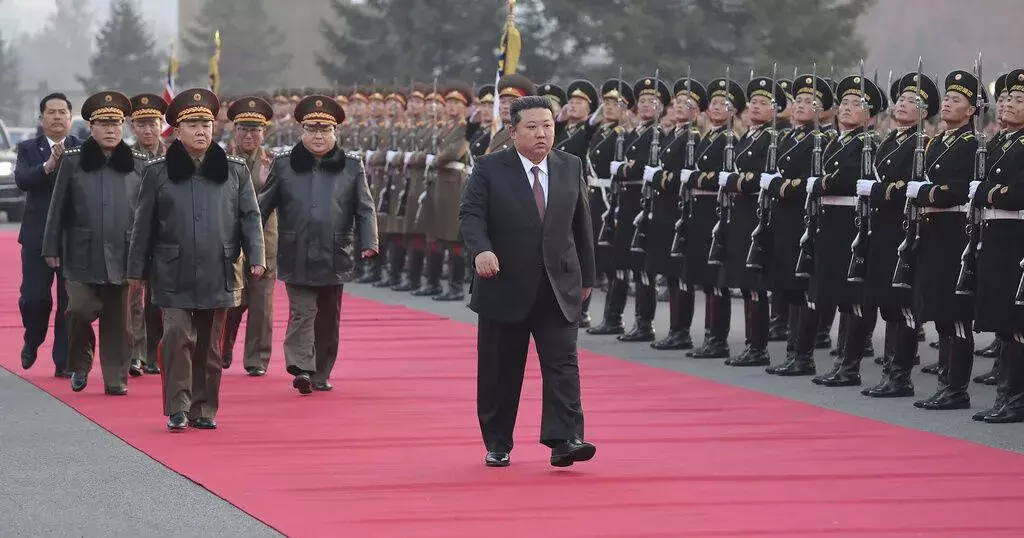
North Korea (PC- Social Media)
There exists a nation on the world map whose political and social architecture continues to remain shrouded in mystery. While countries like India strive relentlessly to raise voter turnout—often struggling to cross the 70–75 percent mark—this nation consistently reports near-total participation. In its recent parliamentary elections, once again, almost 100 percent turnout was recorded, accompanied by near-unanimous support. Such figures set its electoral system apart from the rest of the world and naturally provoke curiosity about how this system actually functions.
Understanding North Korea’s Election System
This country is North Korea. It is often said that while an electoral framework exists here, its purpose is not to facilitate a change of power but to demonstrate the legitimacy of the existing authority. In almost every constituency, there is typically only one candidate—pre-selected by the ruling party. Voters are not presented with a real choice; they can either approve (‘Yes’) or theoretically reject (‘No’) the candidate. However, choosing ‘No’ carries significant social and political risks. Thus, elections here are less about competition and more about publicly affirming loyalty to leadership. This explains why turnout exceeds 99 percent and support approaches 100 percent—figures that are considered routine within this system.
Role of Political Parties and Power Structure
At the center of this political structure lies the Workers’ Party of Korea, which exercises complete control over governance. On paper, two additional parties exist—the Social Democratic Party of Korea and the Chondoist Chongu Party. However, all these parties operate under a single coalition known as the “Democratic Front for the Reunification of Korea.” These entities lack independent political agency; real authority remains firmly in the hands of the Workers’ Party and the Kim leadership.
Voting Process and Public Participation
Unlike democratic systems such as India, there is no competition of electoral symbols or multi-party contests. Since each constituency typically has only one candidate, ballots simply display the candidate’s name along with options for approval or rejection. While voting is not explicitly mandated by law, in practice it is nearly compulsory. Failure to vote may invite administrative scrutiny, as participation is closely tied to demonstrations of loyalty to the state. Consequently, people vote less out of free will and more under social and political pressure.
The voting process itself is distinctive. Electronic Voting Machines (EVMs) are not used; instead, paper ballots are employed. The candidate’s name is pre-printed, and voters are given two options: submitting the ballot without alteration signifies approval, while crossing out the name and placing it in a separate box indicates rejection. However, voting ‘No’ is extremely rare in practice. Thus, election outcomes are largely predetermined.
The simplest way to understand North Korea’s electoral system is this: it is less an election and more a public reaffirmation of allegiance to the state.
Election Campaigns and Media Control
Election campaigns in North Korea are not about seeking votes; they are organized displays of loyalty. Candidates do not campaign—rather, the state and the party conduct the campaign. The media is entirely one-sided. Citizens are mobilized collectively. In India, leaders appeal to voters with promises and policies, while opposition parties critique the government. In North Korea, the message is fundamentally different: voting is a demonstration of unity with the leadership. There is no opposition, no debate. Government posters during elections urge citizens to vote and remain united with the leadership—not against any opponent, but in support of the state. Collective meetings are held, and voting is portrayed as a patriotic duty. Television, radio, and newspapers—all under state control—continuously broadcast this message. Factories, schools, and government offices organize gatherings to emphasize the importance of participation. Local officials ensure that every citizen votes. The core message remains: “This is not merely an election, but proof of your loyalty to the nation.” As a result, there is no debate on issues, no criticism of governance, and no promises of development—making it less a campaign and more a mass mobilization exercise.
Parliament and Governance Structure
North Korea’s parliament is known as the Supreme People’s Assembly, the highest legislative body of the country. It comprises approximately 687 members, each representing a constituency. The entire nation is divided into roughly 687 electoral districts. Elections are typically held every five years, while local assemblies are elected at more frequent intervals. The most recent national election took place on March 15, 2026, covering all constituencies. State media reported exceptionally high voter turnout. However, international analysts often describe this parliament as a body that formally endorses the policies of the ruling Workers’ Party rather than serving as a platform for independent debate or political competition. Notably, Kim Jong-un himself was not listed as a candidate in the 2026 elections, yet it was widely expected that the new assembly would reaffirm his leadership. This highlights a crucial reality: the question is not “Who will win?” but rather “Whom will the system formally endorse?”
Local Elections and Limited Reforms
Local-level elections also take place in North Korea through Local People’s Assemblies at provincial, city, and county levels. The process closely mirrors national elections—one candidate per seat, with voters choosing ‘Yes’ or ‘No’. However, in a notable development during the 2023 local elections, North Korea allowed a limited number of ‘opposition votes’ for the first time in decades. Following amendments to election laws in August 2023, a restricted multi-candidate system was introduced at the local level. Yet, analysts largely viewed this as an attempt to make the system appear more ‘normal’ rather than a genuine step toward political liberalization. On paper, elections exist—but real political competition remains virtually absent.
A Highly Centralized System
From the capital Pyongyang to the smallest towns, North Korea represents a highly centralized system where the distinction between state, society, and individual is almost erased. This is why it is often described as one of the most controlled nations in the world—a place where democratic procedures exist, but their essence has taken on a fundamentally different form.
Kim Jong-un: The Center of Power
At the heart of this entire system stands Kim Jong-un—a leader who embodies not only political authority but also military and ideological control. He represents the third generation of a ruling dynasty that began with Kim Il-sung and was consolidated by Kim Jong-il. Born around 1983 or 1984, Kim Jong-un’s exact birthdate remains uncertain. A significant part of his education took place in Switzerland, where he reportedly studied under an assumed identity. It is believed that during this time he was exposed to Western lifestyles, sports—particularly basketball—and modern technological culture.
Kim Jong-un’s leadership reflects a dual approach. On one hand, he has pursued an aggressive military policy; on the other, he has engaged in diplomatic initiatives—most notably his 2018 meeting with then U.S. President Donald Trump in Singapore, marking the first direct interaction between leaders of the two nations. He has also introduced limited economic reforms, including allowing small-scale market activities and increasing reliance on trade with China. Nevertheless, the economy remains heavily constrained by strict state control and international sanctions.
Leadership Image and Global Perception
His image is equally dualistic: a strict authoritarian ruler and military leader on one side, and a figure influenced by modern and Western aesthetics on the other. He is often associated with a taste for luxury. At the same time, he faces serious allegations, including human rights violations, political repression, and even internal power struggles—such as the reported execution of his uncle. International organizations frequently rank him among the world’s most stringent rulers.
To understand Kim Jong-un, three defining concepts suffice—Dynasty, Absolute Power, and Nuclear Strategy. He is not merely a leader but the focal point of an entire political structure. His authority is not derived from electoral competition but from hereditary succession. He governs not through opposition, but through complete control. On the global stage, he represents both a challenge and an enigma.
Society Under Control
Under his leadership, North Korea has solidified its identity as a nuclear power while maintaining a tightly controlled and disciplined internal society. His governance is not merely administrative—it is the operation of a system where power, ideology, and nation converge into a single center. Without understanding this framework, any discussion of North Korea remains incomplete.
To the outside world, North Korea appears as a land of missiles, military parades, and rigid rhetoric. Yet beneath this exterior lies a functioning society where everyday life continues—schools, workplaces, families, and markets exist, albeit under a distinct framework. It is not merely a political system but a controlled social experiment, where the structure holds precedence over the individual.
Conclusion
In simple terms, elections in North Korea are less a source of power and more a tool for its public validation. To understand North Korea, one must understand Kim.
Kim Jong-un represents a unique convergence of mystery, authority, and nuclear politics—a rare example where a “communist state” has effectively evolved into a structure resembling a hereditary monarchy.